

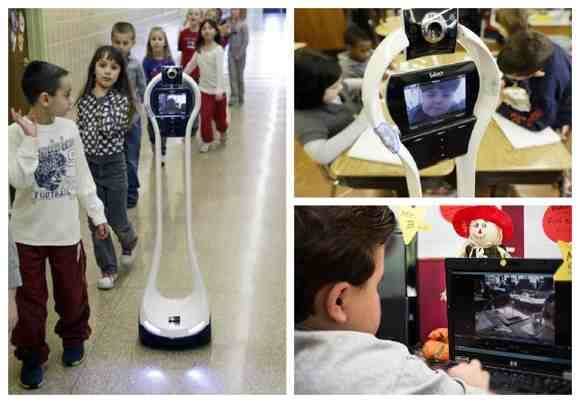
VGo is a telepresence robot developed by Nashua, NH-based VGo Communcations. Since January 2012 it has enabled Devon to attend Winchester Elementary School in West Seneca, NY. He communicates wirelessly with the robot from his home five miles away, navigating it down hallways and into classrooms.
At school Devon has the job of “greeter” where he greets fellow classmates at the school’s entrance in the morning. He speaks through VGo speakers, and the teacher speaks through a microphone and amplifier so that Devon can easily hear her. And when he needs to raise his hand a light on the robot is activated. VGo can run for an entire school day without needing to be recharged – more than can be said for some students I’m sure.
As Winchester Principal Kathleen Brachmann explains, it’s a world of difference between sitting at home alone with your books and being able to participate in classroom discussion or join your friends in the hallway for lockerside chats. “Walking down a hallway, seeing other kids,” she told the Washington Post, “you couldn’t expose somebody on a Skype session that way. It would just be like a TV screen. With this he really gets a feel, a sensation, of being there.”
Of course, getting around with VGo does have its extra work. Before it takes off down a hall, the Segway-looking robot lowers its camera to make sure the area in front of it is clear of objects and small people. It can sense large objects in its path and knows when it comes to a set of stairs. That’s when Devon has to wait for a teacher to lift his VGo. Luckily, the robot only weighs 18 pounds. But robots aren’t cheap. Generously, the school district is covering the $6,000 cost for VGo and the $100 per month service fees.

Devon Carrow uses a telepresence robot to attend school despite illnesses that keeps him at home. [Source: VgoCommunications via YouTube]
Already VGos are being used by kids in New Jersey, Iowa, Wisconsin and Texas to send their personal “avatars” to school while staying safely away due to health reasons. If the rapidly growing number of telepresence robots joining the market is any indication, the number of children telecommuting through robots is likely to increase in the near future. Not to be confined to the classroom, physicians are also already using telepresence robots to be in two places at once and check up on patients that are miles away.
As yet, costs are too high right now for the robots to become a widespread solution, but no doubt more mobile avatars will be scooting down school hallways and hospitals in the future as costs go down. It’s possible that at some point even perfectly healthy and able students may be given the choice to telecommute just because they want to, or they’ll use the robots to participate in some overseas exchange program. As the students who’ve already had their lives enriched by the robots I’m sure feel, the sky’s the limit.

![Triclosan, the antibacterial and antifungal agent in liquid soap and a great many other things may disrupt hormone regulation and contribute to antibiotics resistance in germs. [Source: Wikipedia]](http://singularityhub.com/wp-content/uploads/2013/05/soapA.jpg)
![Smarter Objects combines the intuitive ease of using real objects with the flexibility of virtual ones. [Source: Virtual Labs via Vimeo]](http://singularityhub.com/wp-content/uploads/2013/05/smarter.jpg)


Very interesting, thanks. ‘Huge implications for all of us being able to ‘be’ elsewhere so physically, e.g. being able to remotely ‘be’ in a hardware store robot to find, inspect, and buy things, then put them into a (driverless) taxi to get them home. Or a plumber ‘occupying’ a home’s robot to inspect the property, look under the sink, then give a quote. It leads to robots that also have arms and hands to do things remotely, e.g. kids in a woodworking class or cooking, or the plumber fixing the sink from the cabin of his yacht in a harbour.
With a little work, these devices could be ‘Robocops’, which disabled vetrans can use to help guard our schools, while they stay at home.
Actually, VGo is a very cost-effective solution to a child’s IEP, allowing homebound instruction at a fraction of the cost of tutors. Plus, because the student is able to independently control the VGo, there is no need for a teacher or aide to be constantly be adjusting the student’s view, as is often the case with laptop video conferencing tools. The student is able to remotely attend class from the safety of their home, while still being able to participate in group projects, move from classroom to classroom, attend school assemblies, and socialize with their friends between classes. So VGo also solves the problem of isolation typically seen with homebound instruction.
This is very interesting technology! For some children it could be an amazing link to the outside world. But, I’m worried that for other, more socially-minded students, it could be a bit of a handicap. There are limits to telepresence, and some children are more motivated by social interaction than by one-one-one learning. I think it might be better, in some cases at least, to help these children connect to others who have similar conditions.
For example, in many homeschool situations resulting from religious fundamentalism, many parents network and hold their own private “classrooms”, where they can expose their children to others in their community, while keeping their old religious traditions intact in an almost Amish fashion.
That model could be useful. In this case, these children need to be protected from common food allergens or microbes, but they could still benefit from increased face-to-face contact with other children who have the same limitations.
As far as the use of this technology by non-disabled students, it seems like this might get rid of the common classroom itself. It’s bringing to mind images of the comedy movie (Bueller’s Day Off, was it?) where one student asks another student to tape the professor’s lecture so he can skip class. Then more and more students keep simply bringing in tape recorders, until the entire classroom is just filled with tape recorders, until ultimately the professor himself just brings in a recorded lecture and plays it to the room of tape recorders.
Also, that’s a good idea Robert. Disabled veterans might easily find themselves frustrated when strapped to a chair at home, and giving them something to do that resembles what they were doing in the Army might be helpful. Imagine the difference between a disabled veteran sitting in front a dual-monitor configuration for 8 hours a day, keeping tabs on a security bot, and making rounds, giving him a legitimate sense of purpose, and the same vet sitting in front of a TV screen all day because that’s all he can do, frustrated and maybe even a little angry that his whole life is now a wheelchair since he lost his legs overseas.
On the other hand, we probably won’t have physically disabled people much longer. If the pace keeps up in robot prosthetic limbs, there won’t be very much need for anyone who has lost a limb to remain in that state.
Palmytomo, I think we are a few years away from what you are describing. It’s an inspiring vision, but it represents a very fundamental shift in the way we conduct ourselves; imagine never going to the store again. Is that a good thing or a bad thing?
Yes its convenient, but does it cut out yet another avenue for face-to-face social interaction? It certainly saves on time and transportation costs, but is it sometimes a good thing to get up close and personal with a problem?
A technical problem: how do you control the “hands”? Would you have a glove that translates your movements?