An AI Copilot Quadrupled the Performance of This Wearable Brain-Reading Device
Thanks to AI and an electrode-studded cap, participants controlled a robotic arm with just their thoughts.
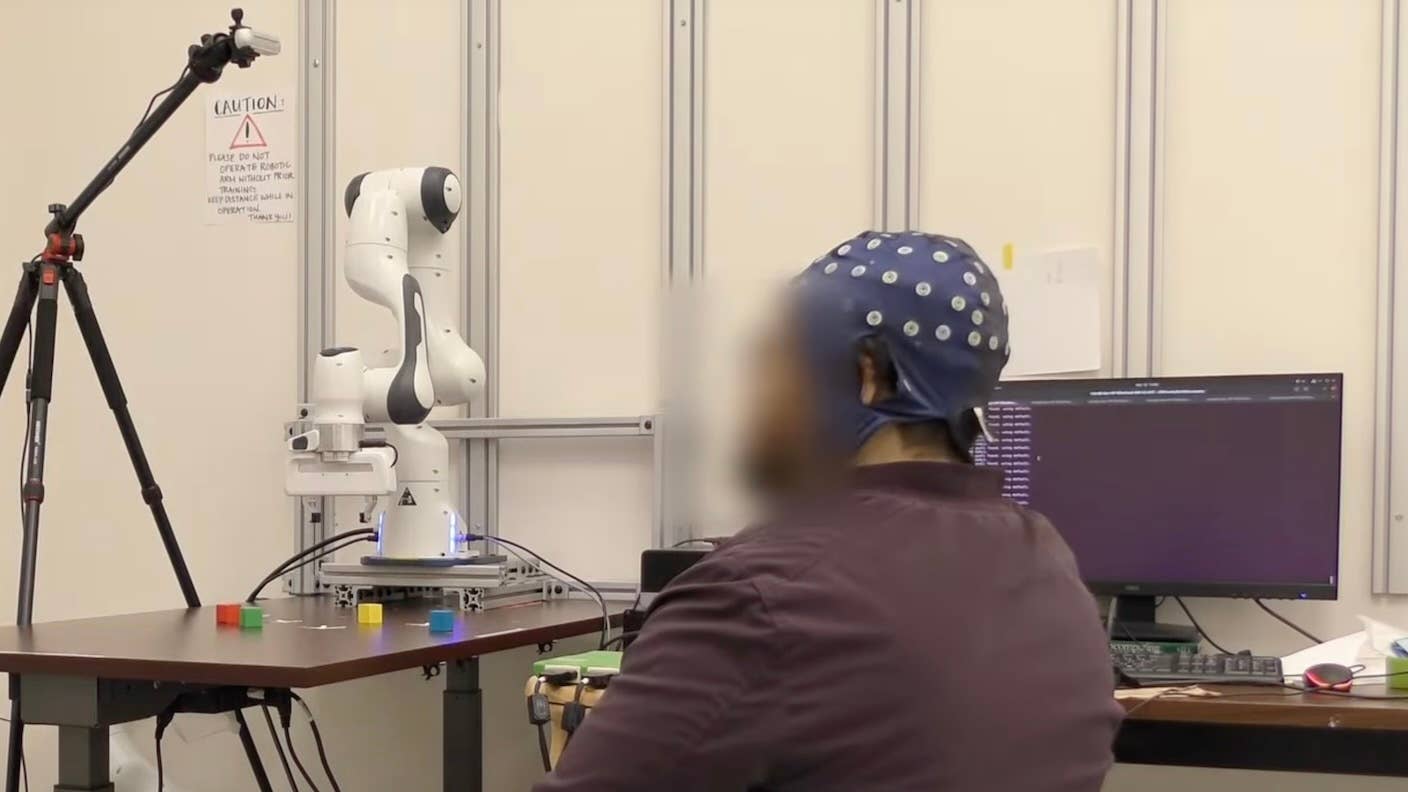
Image Credit
Neural Engineering and Computation Lab/UCLA
Share
A host of tech startups are racing to build brain implants, but there may be limits to how widely such invasive technology can be adopted. New research shows that pairing AI with less invasive brain-computer interfaces could provide another promising direction.
The cutting-edge brain implants being developed by companies like Neuralink and Precision Neuroscience are initially aimed at medical applications. But techno-optimists also hope that in the future this technology could be used by everyday people to boost cognition, control technology with their thoughts, and even merge their minds with AI.
But implanting these devices requires risky brain surgery and can lead to immune reactions that degrade an implant’s performance or even require it be removed. When treating serious disabilities or diseases these risks can often be justified, but the calculus is trickier for healthy people with no real medical need.
There are less invasive brain interfaces that record electrical signals from outside the skull, but they are typically much less accurate at detecting brain signals. Now, researchers from the University of California, Los Angeles have shown that combining these devices with an “AI copilot” can dramatically boost performance and even allow people to control a robotic arm.
“We’re aiming for much less risky and invasive avenues,” Jonathan Kao, who led the research, said in a press release. “Ultimately, we want to develop AI-BCI systems that offer shared autonomy, allowing people with movement disorders, such as paralysis or ALS, to regain some independence for everyday tasks.”
The non-invasive device the researchers used in their experiments was a cap featuring 64 electrodes designed to capture electroencephalography, or EEG, signals. They developed a custom algorithm to decode these signals, which they then combined with AI copilots designed for specific tasks. The system was tested by four study participants, one of whom was paralyzed from the waist down.
The first task was moving a cursor on a computer screen to hover over eight different targets for at least half a second. Using reinforcement learning, the team trained the AI copilot to infer what target the user was aiming for by looking at inputs from the EEG decoder and position data from the targets and cursor. The copilot then used this information help steer the cursor in the right direction.
In a paper in Nature Machine Intelligence, the researchers report that the copilot boosted the success rate of the healthy participants by a factor of two compared to using the interface without AI, while the paralyzed participant saw their success rate quadruple.
Be Part of the Future
Sign up to receive top stories about groundbreaking technologies and visionary thinkers from SingularityHub.

The researchers then had users control a robotic arm with the interface to move four colored blocks on a table to randomly placed markers. The copilot for this task worked on similar principles but used a camera feed to detect the position of blocks and targets on the table.
With the copilot’s aid, the healthy participants solved the task significantly faster. The paralyzed participant was unable to complete the task without help from the copilot, but once it was activated, they were successful 93 percent of the time.
The researchers say the study shows this kind of “shared autonomy” approach—where AI and brain interface users collaborate to solve tasks—can significantly boost the performance of non-invasive technology. They also suggest it could improve invasive implants as well.
In fact, Neuralink is already experimenting with similar approaches. Earlier this year, MIT Technology Review reported that one of the company’s test subjects was using the AI chatbot Grok to help draft messages and speed up the rate at which he could communicate.
However, Mark Cook at the University of Melbourne in Australia told Nature that researchers need to be careful about how much control is given to the AI in these kinds of setups. “Shared autonomy must not come at the cost of user autonomy, and there is a risk that AI interventions could override or misinterpret user intent,” he said.
Nonetheless, it seems the dream of brain-computer interfaces allowing AI and human minds to interact more seamlessly may be arriving ahead of schedule.

Related Articles

Heat Is an Orbital Data Center’s Greatest Foe. These Tiles Dump It at the Source.
Europe Approves Bionic Eye to Restore Vision Lost to Blindness

OpenAI Agent Breaks Free and Hacks Hugging Face
Heat Is an Orbital Data Center’s Greatest Foe. These Tiles Dump It at the Source.
Europe Approves Bionic Eye to Restore Vision Lost to Blindness
OpenAI Agent Breaks Free and Hacks Hugging Face
What we’re reading