Information Could Be a Fundamental Part of the Universe—and May Explain Dark Energy and Dark Matter
The universe may not only be geometry and energy—but also memory. And in that memory, every moment of cosmic history may still be written.
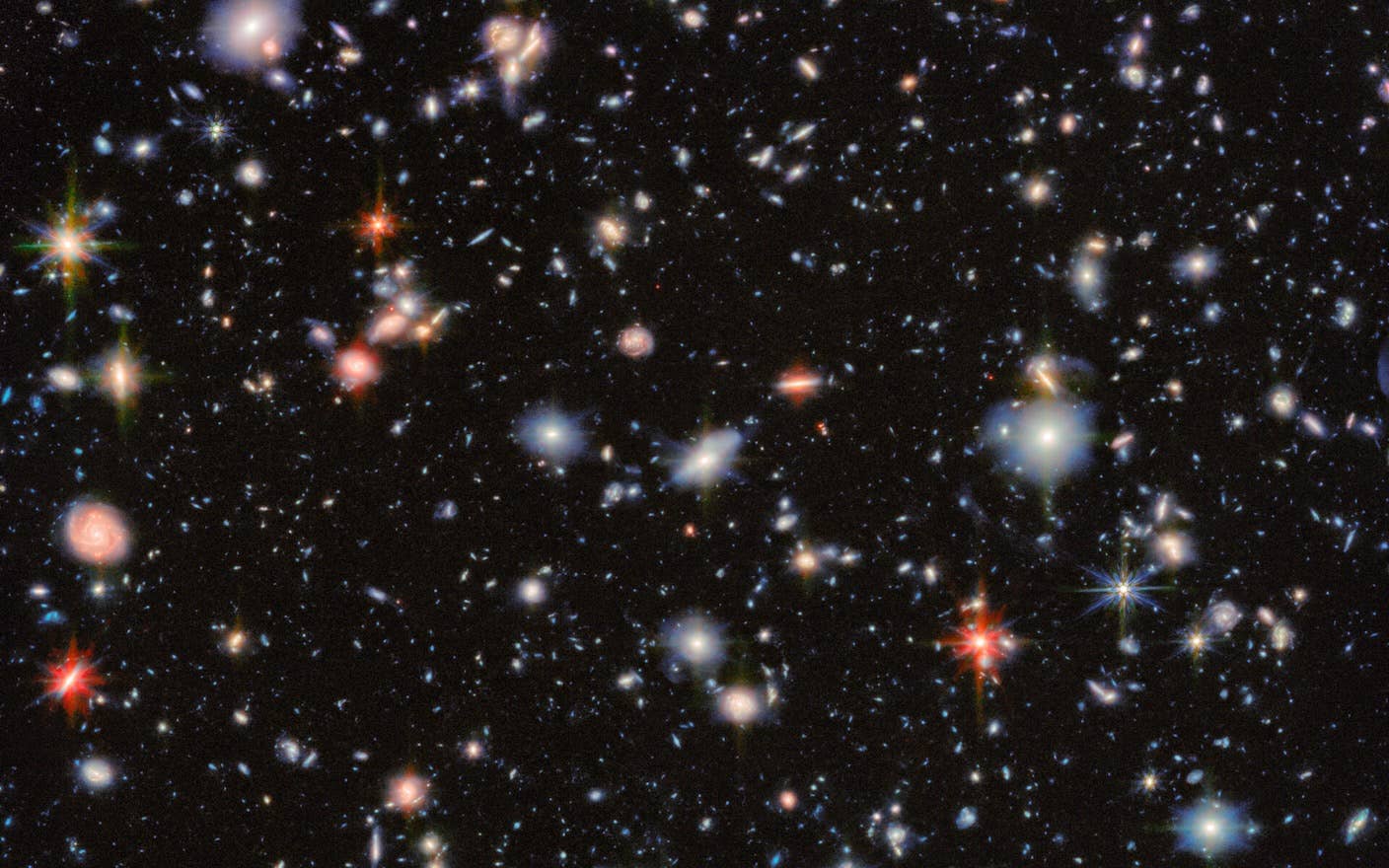
Image Credit
ESA/Webb, NASA & CSA, G. Östlin, P. G. Perez-Gonzalez, J. Melinder, the JADES Collaboration, the MIDIS collaboration, M. Zamani (ESA/Webb)
Share
For more than a century, physics has been built on two great theories. Einstein’s general relativity explains gravity as the bending of space and time. Quantum mechanics governs the world of particles and fields. Both work brilliantly in their own domains. But put them together and contradictions appear—especially when it comes to black holes, dark matter, dark energy, and the origins of the cosmos.
My colleagues and I have been exploring a new way to bridge that divide. The idea is to treat information—not matter, not energy, not even spacetime itself—as the most fundamental ingredient of reality. We call this framework the quantum memory matrix (QMM).
At its core is a simple but powerful claim: Spacetime is not smooth, but discrete—made of tiny “cells,” which is what quantum mechanics suggests. Each cell can store a quantum imprint of every interaction, like the passage of a particle or even the influence of a force such as electromagnetism or nuclear interactions, that passes through. Each event leaves behind a tiny change in the local quantum state of the spacetime cell.
In other words, the universe does not just evolve. It remembers.
The story begins with the black hole information paradox. According to relativity, anything that falls into a black hole is gone forever. According to quantum theory, that is impossible. Information cannot ever be destroyed.
QMM offers a way out. As matter falls in, the surrounding spacetime cells record its imprint. When the black hole eventually evaporates, the information is not lost. It has already been written into spacetime’s memory.
This mechanism is captured mathematically by what we call the imprint operator, a reversible rule that makes information conservation work out. At first, we applied this to gravity. But then we asked: What about the other forces of nature? It turns out they fit the same picture.
In our models assuming that spacetime cells exist, the strong and weak nuclear forces, which hold atomic nuclei together, also leave traces in spacetime. Later, we extended the framework to electromagnetism (although this paper is currently being peer reviewed). Even a simple electric field changes the memory state of spacetime cells.
Explaining Dark Matter and Dark Energy
That led us to a broader principle that we call the geometry-information duality. In this view, the shape of spacetime is influenced not just by mass and energy, as Einstein taught us, but also by how quantum information is distributed, especially through entanglement. Entanglement is a quantum feature in which two particles, for example, can be spookily connected, meaning that if you change the state of one, you automatically and immediately also change the other—even if it’s light years away.
This shift in perspective has dramatic consequences. In one study, currently under peer review, we found that clumps of imprints behave just like dark matter, an unknown substance that makes up most of the matter in the universe. They cluster under gravity and explain the motion of galaxies—which appear to orbit at unexpectedly high speeds—without needing any exotic new particles.
In another, we showed how dark energy might emerge too. When spacetime cells are saturated, they cannot record new, independent information. Instead, they contribute to a residual energy of spacetime. Interestingly, this leftover contribution has the same mathematical form as the “cosmological constant,” or dark energy, which is making the universe expand at an accelerated rate.
Its size matches the observed dark energy that drives cosmic acceleration. Together, these results suggest that dark matter and dark energy may be two sides of the same informational coin.
Be Part of the Future
Sign up to receive top stories about groundbreaking technologies and visionary thinkers from SingularityHub.

A Cyclic Universe?
But if spacetime has finite memory, what happens when it fills up? Our latest cosmological paper, accepted for publication in The Journal of Cosmology and Astroparticle Physics, points to a cyclic universe—being born and dying over and over. Each cycle of expansion and contraction deposits more entropy—a measure of disorder—into the ledger. When the bound is reached, the universe “bounces” into a new cycle.
Reaching the bound means spacetime’s information capacity (entropy) is maxed out. At that point, contraction cannot continue smoothly. The equations show that instead of collapsing to a singularity, the stored entropy drives a reversal, leading to a new phase of expansion. This is what we describe as a “bounce.”
By comparing the model to observational data, we estimate that the universe has already gone through three or four cycles of expansion and contraction, with fewer than 10 remaining. After the remaining cycles are completed, the informational capacity of spacetime would be fully saturated. At that point, no further bounces occur. Instead, the universe would enter a final phase of slowing expansion.
That makes the true “informational age” of the cosmos about 62 billion years, not just the 13.8 billion years of our current expansion.
So far, this might sound purely theoretical. But we have already tested parts of QMM on today’s quantum computers. We treated qubits, the basic units of quantum computers, as tiny spacetime cells. Using imprint and retrieval protocols based on the QMM equations, we recovered the original quantum states with over 90 percent accuracy.
This showed us two things. First, that the imprint operator works on real quantum systems. Second, it has practical benefits. By combining imprinting with conventional error-correction codes, we significantly reduced logical errors. That means QMM might not only explain the cosmos, but also help us build better quantum computers.
QMM reframes the universe as both a cosmic memory bank and a quantum computer. Every event, every force, every particle leaves an imprint that shapes the evolution of the cosmos. It ties together some of the deepest puzzles in physics, from the information paradox to dark matter and dark energy, from cosmic cycles to the arrow of time.
And it does so in a way that can already be simulated and tested in the lab. Whether QMM proves to be the final word or a stepping stone, it opens a startling possibility: The universe may not only be geometry and energy. It is also memory. And in that memory, every moment of cosmic history may still be written.
This article is republished from The Conversation under a Creative Commons license. Read the original article.

Florian Neukart is widely recognized as a leading figure in high technology, innovation, and future tech. With extensive experience in academia, industry, and consulting, he has established himself as a trusted advisor and practitioner in artificial intelligence and quantum computing. Holding a PhD in computer science from the Transilvania University of Brasov, Florian has a solid academic foundation for his multifaceted career. Complementing his doctoral studies, Florian obtained a master’s degree in physics from the Liverpool John Moore's University, a master's degree in information technology from the CAMPUS02 University of Applied Sciences in Graz, an engineer's degree in computer science from the Joanneum University of Applied Sciences in Kapfenberg. Currently serving as the executive board member for product at Terra Quantum AG, as the director for exponential technologies at the Quantum Economy Institute, and on board of trustees of the International Foundation of Artificial Intelligence and Quantum Computing, Florian also holds a special advisory role at the Quantum Strategy Institute and serves on the board of advisors of KI Park. He has contributed significantly to shaping Germany's approach to quantum computing as a co-author of the National Roadmap for Quantum Computing and sits on the advisory board of Quantum.Tech. Florian's expertise has also been sought after on the global stage, as evidenced by his membership in the World Economic Forum's Future Council on Quantum Computing. Before his tenure at Terra Quantum AG, Florian spent 11 years at Volkswagen Group, where he held various positions culminating in his role as director of the Group's innovation labs in Munich and San Francisco. His career trajectory has been marked by a fusion of academic rigor and practical application, reflected in his diverse educational background. Florian holds master's degrees and diplomas in computer science, physics, and information technology, alongside a Ph.D. in computer science, focusing on the convergence of artificial intelligence and quantum computing. In addition to his professional endeavors, Florian is actively engaged in academic research and teaching. As an assistant professor at the Leiden Institute of Advanced Computer Science, he imparts his expertise in quantum computing to the next generation of scholars. Florian's scholarly contributions extend beyond the classroom, encompassing authored books on artificial intelligence and energy and editorial roles in publications focused on quantum computing.
Related Articles

What We Actually See—and Don’t See—Shows Consciousness Is Only the Tip of the Iceberg
These Mini Brains Just Learned to Solve a Classic Engineering Problem
New Device Detects Brain Waves in Mini Brains Mimicking Early Human Development
What We Actually See—and Don’t See—Shows Consciousness Is Only the Tip of the Iceberg
These Mini Brains Just Learned to Solve a Classic Engineering Problem
New Device Detects Brain Waves in Mini Brains Mimicking Early Human Development
What we’re reading