More Space Junk Is Plummeting to Earth. Earthquake Sensors Can Track It by the Sonic Booms.
Scientists are co-opting seismic sensors to detect space debris streaking through the atmosphere at hypersonic speeds.
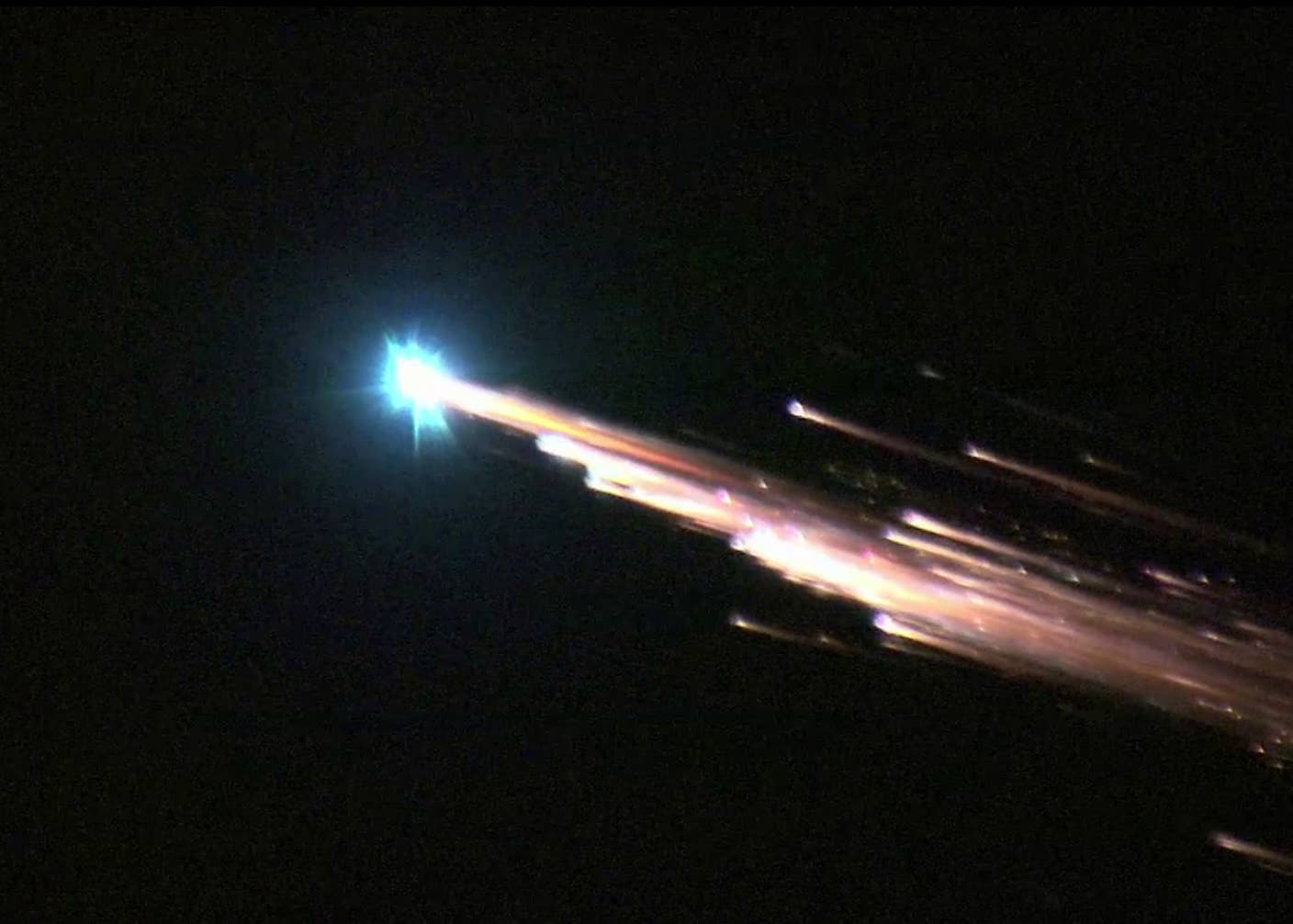
Image Credit
ESA/NASA
Share
In the early morning of April 2, 2024, the sky over southern California lit up with flashes of blazing light. Residents were bewildered. Were they missiles? A crashing plane? The unusual activity confused even experts—until they realized it was a disposable part of China’s Shenzhou-15 spacecraft burning up in the atmosphere as it returned to Earth.
Scientists knew the event was on the horizon and had mapped out a potential entry point over the northern Atlantic Ocean, thousands of miles from metropolitan Los Angeles. Luckily, no one was hurt as the module broke apart over the city.
But the incident underlined an uncomfortable truth. We’re nowhere near being able to accurately predict the path of space debris as it rains down. As more spacecraft are launched and reenter the atmosphere, damage to infrastructure and Earthlings is only a matter of time.
Researchers are looking into a solution from an unexpected source: sensors that measure earthquakes. As space debris plummets to the ground at hypersonic speeds, it generates a sonic boom. This causes a slight tremor in the ground that the sensors readily register.
Using data from a network of these sensors, Benjamin Fernando at Johns Hopkins University and Constantinos Charalambous at Imperial College London developed a system that can reconstruct the path of space debris with unprecedented accuracy. They used the system to map Shenzhou-15’s speed, altitude, gradual disintegration, and final destination.
To be clear, this isn’t an early warning system. Because sonic booms lag behind the objects causing them, the method is like a forensic reconstruction of space debris’ final journey. Still, it can quickly identify potential fall-out zones for faster retrieval and cleanup, which is especially important if the junk is toxic or radioactive.
The work is “a crucial step toward near-real-time monitoring of natural and anthropogenic objects entering from space,” wrote Chris Carr at the Los Alamos National Laboratory, who was not involved in the work.
An Embarrassment of Riches
Launching satellites was once a colossal undertaking. But thanks to innovations by SpaceX and national space agencies across the world, it’s becoming far more routine.
These spacecraft have already changed life on Earth. Thousands of Starlink satellites beam the internet to previous dead zones and disaster areas. Miniature satellites are now an affordable research platform scientists use to profile weather, measure solar winds, and track the effects of microgravity and radiation on living cells. And a new space race will only grow the fleets of spacecraft already blanketing the Earth.
“The big change that we’ve seen since 2020 is the rise of satellite mega-constellations…companies not putting up a dozen spacecraft, but maybe a thousand or ten thousand over the course of a few years,” Fernando told Science.
Mega-constellations have already caused problems for scientists by polluting astronomical images with bright streaks. They may also increase the rate at which space debris rains down. In a paper describing their system, Fernando and Charalambous write that in 2025 there were roughly four to five re-entries a day, and the numbers are likely to rapidly grow.
We already monitor spacecraft in orbit. Telescopes bring real-time visuals. Radar tracks location and speed. But these tools struggle as a spacecraft drifts into the Earth’s upper atmosphere.
The interaction between fragments and air becomes “really chaotic,” said Fernando. “We can no longer predict with particularly good accuracy exactly where [and when] a piece of re-entering space debris is going to enter the atmosphere.”
Radar can track spacecraft parts as they return to Earth, but the technology is limited to small regions of the world and barely covers the oceans. Even when we know the final fate of a piece of debris, it’s often difficult to reconstruct its full trajectory.
Be Part of the Future
Sign up to receive top stories about groundbreaking technologies and visionary thinkers from SingularityHub.

Supersonic Waves
The new work was inspired by the way scientists track meteoroids using a dense network of earthquake sensors to detect tiny vibrations in the ground.
The Shenzhou-15 capsule entered the atmosphere going roughly 25 to 30 times the speed of sound. Like a fighter jet, it triggered a powerful sonic boom roughly 80 kilometers (50 miles) above the ground. The boom traveled to Earth’s surface where seismic sensors detected it.
It’s like picking up an earthquake, only “in this case the waves are coming from up versus with earthquakes they tend to come from down,” said Fernando.
Southern California is heavily dotted with seismic sensors, each measuring activity in a small area. To model the spacecraft’s path and speed, the team compiled the largest sonic boom each sensor registered and its arrival time and compiled the data into a map.
The map captured where, when, and how the capsule broke down as it hurtled through the atmosphere. Earlier on, the sensors recorded large, discrete signals. These later became more scattered and complex, suggesting the capsule gradually disintegrated rather than blowing up all at once.
The results are “consistent with on-ground observations, including videos and witness reports of multiple fireballs flying across the sky,” wrote Carr. After more deeply combing through the data, the team showed it could also be used to measure the size of each piece of decaying debris.
The spacecraft’s sonic signature differed from those generated by meteorites, making it possible to tease apart human-made objects and those of natural origins.
Differentiating the two categories is key. Meteorites pose “kinetic risk” as chunks slam into the ground, damaging cars, houses, and other infrastructure. Human space debris, however, could also contain metals, toxic or flammable material, or in rare cases, radioactive components. The model also reconstructed how different parts of the spacecraft disintegrated, potentially making it easier to predict whether chunks have burned up completely in the atmosphere or have reached the ground, making it useful for recovery or clean-up missions.
Crash-and-burn isn’t a spacecraft’s only destiny. Engineers are also working to move defunct satellites into higher orbits that would be stable for “thousands of years” according to Fernando, though this doesn’t solve the space junk problem. Other researchers are exploring ways to design spacecraft such that they completely burn up both safely and predictably.
For now, the technology works best in places with lots of seismic sensors, which are rare. But there’s a push to add sensors in places that are vulnerable due to sensitive ecology or geology at prices far lower than building radar systems to track re-entry, said Fernando.

Dr. Shelly Xuelai Fan is a neuroscientist-turned-science-writer. She's fascinated with research about the brain, AI, longevity, biotech, and especially their intersection. As a digital nomad, she enjoys exploring new cultures, local foods, and the great outdoors.
Related Articles
NASA Unveils Its $20 Billion Moon Base Plan—and a Nuclear Spacecraft for Mars
The US Plans to Break Ground on a Permanent Moon Base by 2030. Here’s What It Will Take.
Elon Musk Says SpaceX Is Pivoting From Mars to the Moon
NASA Unveils Its $20 Billion Moon Base Plan—and a Nuclear Spacecraft for Mars
The US Plans to Break Ground on a Permanent Moon Base by 2030. Here’s What It Will Take.
Elon Musk Says SpaceX Is Pivoting From Mars to the Moon
What we’re reading