Precise Gene Editing in Early Human Embryos Reignites the ‘Designer Baby’ Debate
The technology, still far from clinical use, could one day prevent devastating diseases. But critics warn that even these early results may also fuel interest in commercial embryo editing, despite unresolved ethical and safety concerns.
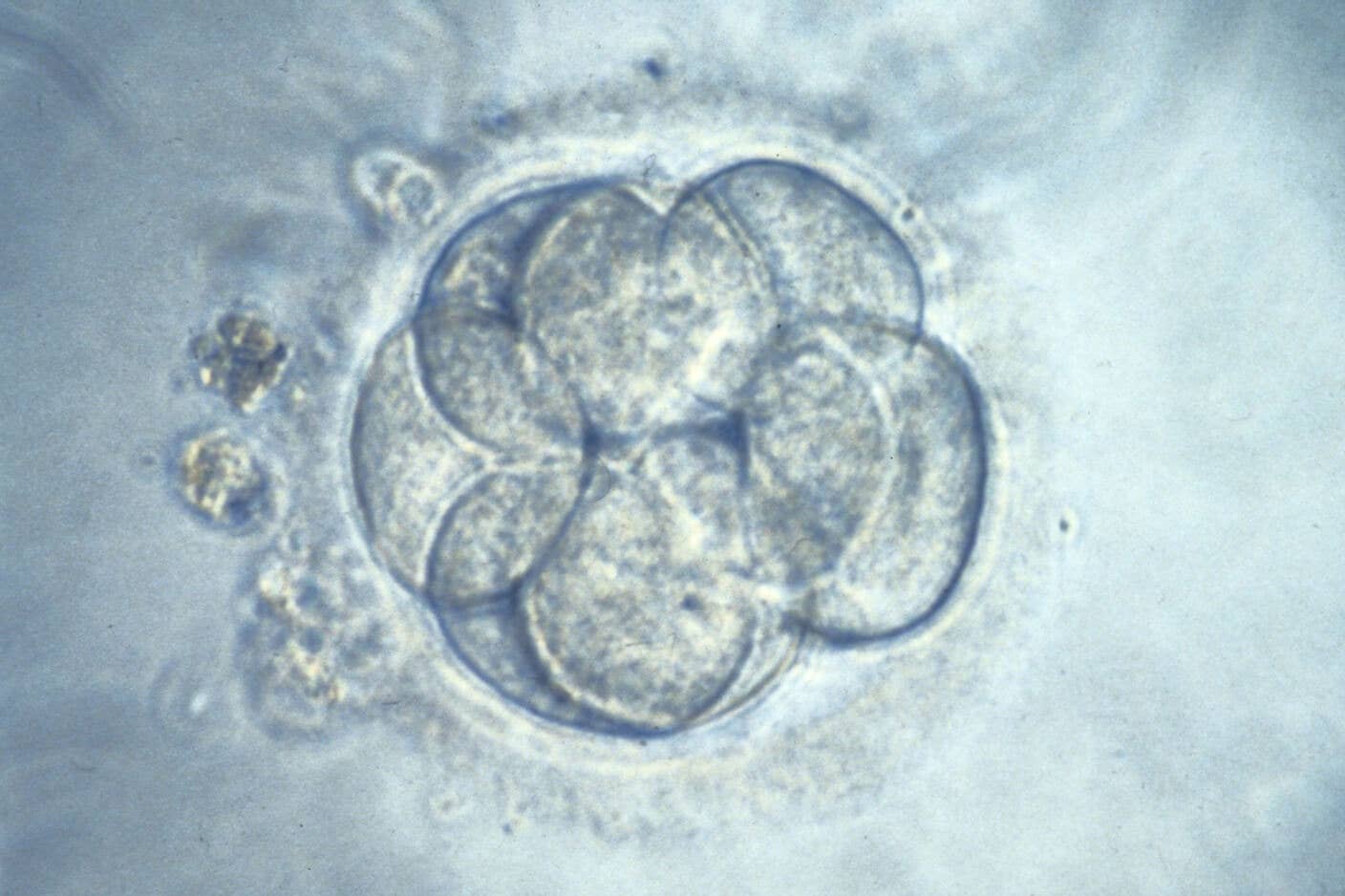
Image Credit
Human embryo from IVF. K. Hardy/Wellcome Collection
Share
Scientists at Columbia University have used a precise gene-editing tool, base editing, to make changes in three disease-linked genes in early-stage human embryos. The goal wasn’t to create pregnancies, but to test the safety and limits of rewriting DNA at the very early stages of life.
The paper, not yet peer reviewed, sparked immediate controversy. Some researchers hailed it as a technical milestone that could one day prevent devastating inherited diseases before birth. Others warned it edges society closer to the prospect of “designer babies”—an idea bioethicists have argued is akin to modern eugenics.
The debate is hardly hypothetical. The work has already attracted commercial interest. New York-based Nucleus Genomics, which screens in vitro fertilization (IVF) embryos for serious genetic disorders, has also developed predictive models for complex traits such as intelligence. The company plans to sponsor future research by study leader Dieter Egli and team.
Critics worry that even experimental advances could fuel demand from wealthy patients while encouraging companies to develop and market embryo-editing technologies, despite unresolved ethical and safety concerns.
Egli argues the findings should be public precisely because these debates are no longer academic curiosity. He has repeatedly called for scientists, regulators, and the public to weigh the pros and cons of editing human embryos. As for clinical use today, his position is unequivocal: “You can’t use it. It’s as clear as day and night,” he told Nature.
Conceptual Shift
Why edit embryos at all?
Cells in an early embryo eventually give rise to every tissue in the body. Correct a harmful mutation at the start of development, and the fix could, in theory, propagate throughout a child’s entire body—and even be passed on to future generations.
The strategy could help in genetic disorders that hamper fetal development or trigger diseases in newborns. For some developmental and metabolic conditions, intervention after birth may already be too late. Even when treatment is possible, gene editors must be able to target various organs, which is an ongoing challenge.
In various efforts, scientists have already repaired disease-causing mutations in mouse embryos and fetuses, including those linked to blood disorders. But mice aren’t humans. Early embryos from the two species repair DNA damage in fundamentally different ways, making it tough to gauge whether a strategy that works in mice will succeed, or prove safe, in people. That uncertainty has fueled interest in testing gene-editing tools directly in human embryos.
Not everyone is on board. International scientific groups have repeatedly called for a temporary ban on editing human embryos, and the practice is illegal in several countries.
That didn’t stop Chinese scientist He Jiankui. In 2018, he announced the birth of gene-edited babies after using a tool called CRISPR-Cas9, claiming the changes would protect them against HIV infection. Global outrage ensued.
By then, years of research had already highlighted CRISPR’s risk. The tool cuts both strands of DNA and relies on the body’s repair machinery to stitch them back together. But the process can go awry, introducing unintended mutations, deleting large chunks of DNA, or altering the wrong locations on the DNA strands altogether. He’s reckless experiment resulted in three years of imprisonment, although he still defends the work.
Subsequent studies only deepened concerns. In some cases, CRISPR editing in human embryos caused extensive genetic damage. In one study, it completely destroyed the chromosome that housed the target gene.
An Imperfect Upgrade
The new study tested a next-generation gene editor designed to overcome some of CRISPR's biggest shortcomings.
Egli and team used an approach called base editing, which rewrites individual DNA letters. Unlike CRISPR, base editing only nicks the DNA strands and is generally thought to be more precise. The technology hit a major milestone last year when it helped cure a baby with a potentially fatal genetic disorder, and earlier lab studies hinted it could also succeed in human embryos.
Working with early-stage embryos, the team edited three genes with the potential to cause illness. In each case, they converted the genetic letter A to G at precise locations. One of the genes, PCSK9, regulates “bad” cholesterol levels. Mutations are associated with a high risk of heart problems. The team's edit was designed to switch off the gene, mirroring strategies already being explored in adults.
The other two targets, HBG1 and HBG2, control production of fetal hemoglobin, an oxygen-carrying protein. The edits made here reflected a natural protective variant that could lessen symptoms in blood disorders, such as sickle cell disease and beta thalassemia.
Be Part of the Future
Sign up to receive top stories about groundbreaking technologies and visionary thinkers from SingularityHub.

The team found no signs of widespread DNA damage, suggesting the tool is more precise than CRISPR. But it wasn’t perfect. Many embryos emerged as so-called genetic mosaics, with some cells carrying the intended edit and others retaining their original genetic blueprint.
That’s a huge problem. As an embryo develops, unedited cells could outcompete edited ones, leaving the disease-causing mutation largely intact. In some embryos, edited cells stopped dividing altogether.
And a lack of obvious chromosome damage doesn’t guarantee safety. The edits could still trigger harmful effects that aren’t noticeable until after birth—when it’s already too late to reverse them.
Calls for Scrutiny
Egli stresses that embryo editing is still far from being ready for the clinic. “These base editors—they can have damaging effects on the embryo. So why would you use it if you don’t fully understand that?” he told Nature.
His team is now working to reduce mosaicism and plans to test the technology in embryos that have developed to roughly 100 cells. This is when fertility clinics typically evaluate and freeze embryos.
Speaking to The New York Times, fertility expert Paula Amato at Oregon Health & Science University, who was not involved in the work, called the strategy “promising.” Genomics researcher Greg Neely at the University of Sydney in Australia also praised the work: “This will go down in history in a positive way—less reckless, more careful and ethical than previous attempts.”
Others remain deeply skeptical. Critics argue that embryo editing permanently alters the genetic inheritance of future generations, who have no say in the decision. The study’s ties to Nucleus Genomics also raised eyebrows. The company previously drew controversy for developing genetic predictions for traits such as intelligence and height and for its slogan “have your best baby.”
To Kian Sadeghi, CEO and cofounder of Nucleus, embryo editing extends that vision. The technology could help couples carrying mutations who struggle to produce enough unaffected embryos for selection during IVF.
Fyodor Urnov at the University of California, Berkeley, who was not involved in the study, isn’t convinced. IVF clinics already screen embryos for many inherited disorders without altering their DNA. Given the risks, selecting an unaffected embryo is often a safer option than rewriting its genome.
“In practical terms, therefore, this preprint will solely impact the rapidly growing movement of embryo editors for purposes of ‘baby improvement’,” he said.
That movement, once taboo, is gaining steam. Yet the traits most often cited by proponents—height, intelligence, emotional regulation—are shaped by hundreds or even thousands of genes, which scientists still don’t fully understand. Such enhancements are far beyond the reach of today's technology. Every additional edit also increases the chance of unintended consequences.
For Egli, that's precisely why the research should be discussed openly. “Research is necessary to provide information to discourage the wrong use of a technology,” he said.

Related Articles
Epigenetic Editing Could Wipe Out Chronic Hepatitis B Infections
Google DeepMind Gives AI-Designed Proteins a Watermark

How Would AI Actually Kill All Humans? Here Are the Top 5 Scenarios
Epigenetic Editing Could Wipe Out Chronic Hepatitis B Infections
Google DeepMind Gives AI-Designed Proteins a Watermark
How Would AI Actually Kill All Humans? Here Are the Top 5 Scenarios
What we’re reading