Study Could Help Explain Why Colder Body Temperature Extends Lifespan in Many Species
By chilling roundworms, scientists traced a molecular pathway hinting at one way cold might extend lifespan.
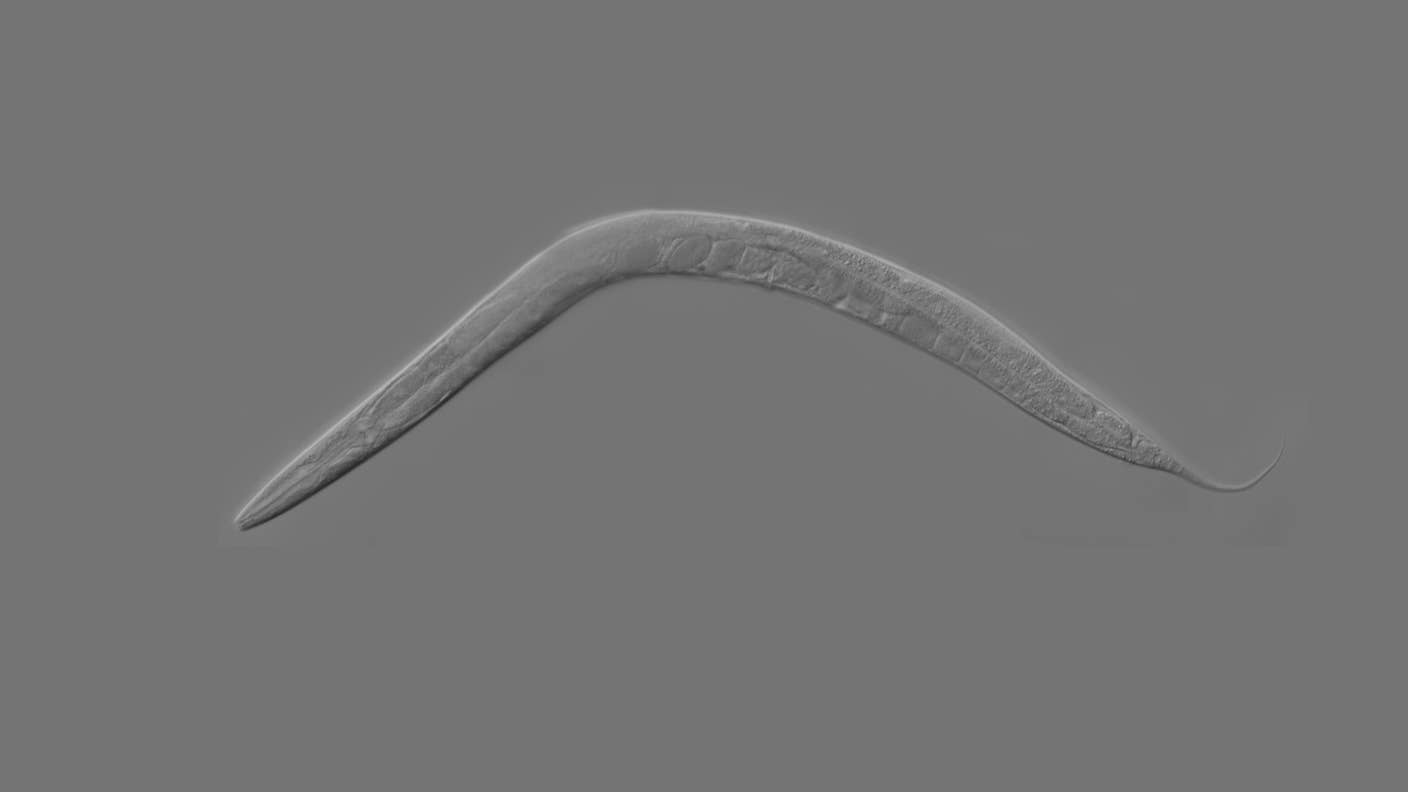
Image Credit
C. elegans / Zeynep F. Altun on Wikimedia Commons
Share
From ice baths and cold showers to whole-body cryotherapy, cold exposure has long been hyped as a wellness shortcut. The supposed benefits include boosted dopamine, weight loss, stronger immunity, or even slower aging.
Scientific evidence for these claims is scant, but a telltale link between temperature and longevity has intrigued scientists for over a century. Lowering ambient temperature by just a smidge can extend lifespan in the roundworm C. elegans, fruit flies, and even mice. Plenty of mechanisms could explain the curious effect, but scientists are still largely in the dark.
A new study may shed some light on the matter. When scientists grew roundworms at moderately cold temperatures, the worms steadily ramped up production of BH2, a helper agent for many enzymes, including those that build brain chemicals. Though initially produced in our muscles, BH2 roams to other parts of the body too, including the intestines and brain. Here, in the study, it boosted tyrosine production and contributed to a longer lifespan.
Mapping a longevity pathway in worms isn’t just about satisfying scientific curiosity. When the scientists supplemented human cells with BH2 or tyrosine, the treatments fended off toxic protein clumps associated with neurodegenerative diseases.
But don’t go ordering tyrosine just yet. A biological response in cells doesn’t automatically translate into a health benefit, especially one as complex as slowing aging. While worms are a useful model in longevity studies, they’re a far cry from humans. That said, an existing drug used to treat a metabolic condition can tweak the pathway, and examining clinical data from patients taking the drug could offer a useful test to see if the mechanism holds up in people.
More broadly, the findings point to muscles as active players in the aging process. Beyond movement, their chemical output could change how other tissues age. The findings “highlight the muscle’s ‘metabolome’—its full set of metabolites—as a potential source of signals that promote longevity,” wrote Hanseul Lee and Seung-Jae Lee at the Korea Advanced Institute of Science and Technology, who were not involved in the study.
Cold Case
As time ticks by, basic cell functions gradually falter. DNA’s protective end caps, called telomers, fray. Mutations accumulate in our genetic blueprint. Chronic inflammation flares across the body. Senescent “zombie” cells bathe healthy tissues in a toxic chemical brew. Cellular energy factories and waste disposal plants begin to sputter.
Dubbed the hallmarks of aging, these processes only partly depend on genetics. Environment, social factors, and lifestyle—diet, exercise, exposure to toxins—also shape our aging trajectory.
Temperature seems like an odd addition to that list. Yet nature is littered with examples. Hibernating mammals generally live longer than those who don’t. Yellow-bellied marmots, for example, spend up to seven months a year hibernating, lowering their body temperature and throttling metabolism. Scientists have found their biological aging essentially stalls during hibernation.
These observations inspired the rate-of-living theory, which suggests that the lower a creature’s metabolic rate, the longer it lives. Recent work has given the century-old idea a nuanced update by exploring how cooler temperatures directly activate mechanisms that counter some of the hallmarks of aging. But there are caveats.
Take mitochondria, our cells’ energy factories. With age, they become increasingly dysfunctional. A chill activates brown fat, which is packed with mitochondria, ramping up energy use and potentially overall metabolic health. In a small study of a dozen people exposed to mild cold for up to eight hours, most showed signs of better blood sugar regulation. But these were short-term effects, not evidence for lasting protection. Cold can also boost mitochondrial numbers, though whether they protect against aging in humans remains to be seen.
The immune system may also respond to a chill. A study in healthy people and those with inflammatory disease, found cold exposure slashed immune molecules called cytokines, which often fuel inflammation. A different study found lower temperatures slowed the accumulation of reactive oxygen species (little “bullets” that damage cellular components, including DNA).
A cellular waste removal plant, the proteasome, also seems to benefit from air conditioning. In 2023, David Vilchez at the University of Cologne and colleagues found that moderately cold temperatures boosted proteasome activity in both C. elegans and human cells. The newly invigorated cleanup crew chomped proteins known to aggregate into clumps involved in neurodegenerative diseases.
Be Part of the Future
Sign up to receive top stories about groundbreaking technologies and visionary thinkers from SingularityHub.

“Lowering body temperature is one of the most effective mechanisms to extend longevity,” the team wrote at the time. But translating those ideas into a practical strategy isn’t straightforward—continuously maintaining a low body temperature is a hard sell. Mimicking those effects in a pill, however, might be easier to swallow.
A Cool Way to Live Long
In the new study, Vilchez’s team compared metabolites in C. elegans grown at a comfortable 20 degrees Celsius (68 degrees Fahrenheit) with those in worms kept at temperatures five degrees lower. On average, the chilled worms lived roughly 15 percent longer.
The levels of one metabolite, BH2, skyrocketed in the cold. The molecule helps a host of enzymes do their jobs, and genetically blocking its production wiped out the extra longevity.
The team found BH2 was mostly produced in muscles and transported to other organs. In the intestines and brain, it shifted into another form that pushed cells to make more tyrosine, an amino acid often found in meats, fish, diary, and soy. Even without a cold snap, feeding tyrosine to worms unable to make BH2 helped them live longer.
“We were genuinely surprised to find the supplementation significantly extended lifespan, even at standard and warmer temperature,” said Vilchez in a press release.
The team then tested BH2 in human neurons. Mutant proteins related to Huntington’s disease, amyotrophic lateral sclerosis, and dementia often trigger cell death, but cells treated with BH2 largely escaped this fate. Meanwhile, they better maintained protein homeostasis, the delicate balance between making, folding, and clearing proteins that goes awry with age.
These findings suggest a way to mimic the benefits of cold without having to tolerate the shivers or dangerous health effects. But a designer pill is a long way off. Safety is one concern. In mammals, a balance between BH2 and its active version regulates reactive oxygen species. Supplementation may tip that balance, causing cells to pump out more “bullets” and ironically accelerate aging. And because the pathway controls other enzymes, unexpected side effects could do more harm than good.
For now, the takeaway isn’t to stock up on BH2 or tyrosine as a fountain of youth. Rather, the results are a good starting point for the development of metabolite-based treatments for neurodegenerative disorders. And instead of going after therapies that target the aging body as a whole, the results suggest focusing on one tissue could be enough.
“These findings suggest that specifically targeting a single tissue, such as muscle, could provide organism-wide protection. This opens up new avenues for therapeutic approaches,” said Vilchez.

Related Articles
New AI Tool Could Help Scientists Make ‘Rare’ Cross-Disciplinary Leaps

The Oldest Living Land Animal Is 194. DNA May Now Reveal the Secret to His Longevity.

This AI Reconstructs What You’re Looking at From a Brain Scan
New AI Tool Could Help Scientists Make ‘Rare’ Cross-Disciplinary Leaps
The Oldest Living Land Animal Is 194. DNA May Now Reveal the Secret to His Longevity.
This AI Reconstructs What You’re Looking at From a Brain Scan
What we’re reading