This AI Learned Language From the Recordings of a Baby’s First 1,000 Days
AI models that learn like kids could reveal the secrets of our early years and inspire more efficient machine minds.
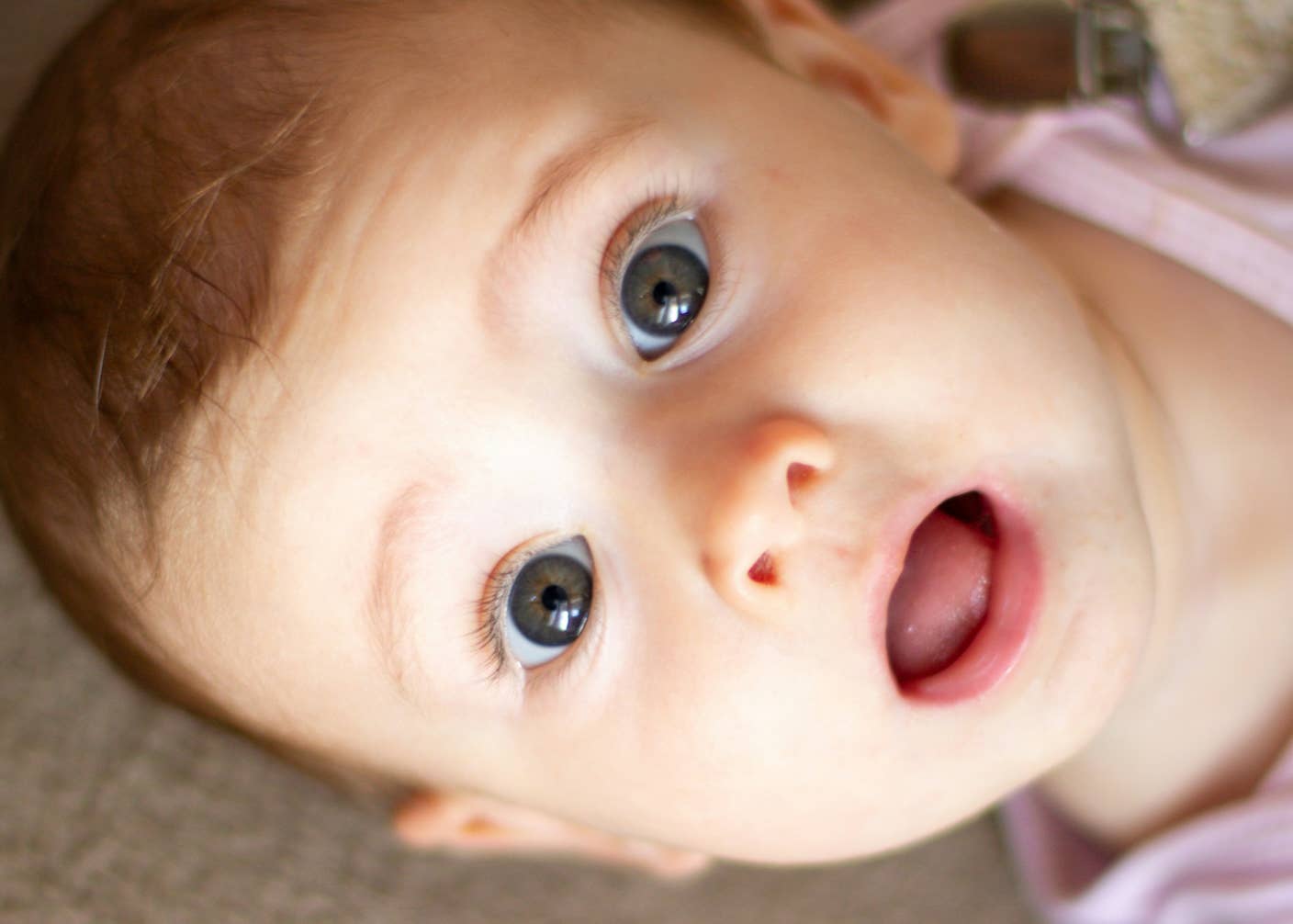
Image Credit
essica Hearn on Unsplash
Share
Babies are linguistic geniuses. Born into a noisy, chaotic world, they gradually distill incomprehensible sounds into words. Within two years, they can recognize thousands of words, follow complex sentences, and shout out their needs.
How they achieve this feat has long puzzled scientists. Babies develop language skills from an intimate world—the voices of their parents, chatter from strangers, nightly bedtime stories. A few hours of speech is enough to get them started.
This is a stark contrast to large language models (LLMs), which need to devour billions of words to mimic human conversation. Chatbots and AI agents are transforming how we interact with the digital sphere. But they guzzle water and energy, and signs that read “no data centers” now line neighborhood streets.
Building AI models that learn language the way babies do could reveal the secrets of our early years—including what happens when learning goes awry—and inspire more efficient machine minds.
An unusual study from Princeton University takes us a step closer. Using recordings from cameras and microphones from eight households, the team captured everyday sounds surrounding children from birth to roughly three years of age. These sonic diaries created a dense record of their waking lives. The researchers then built an AI learner for each child. Like a digital clone, each model experienced the child’s speech environment as it unfolded over time, rather than being trained on all the data in one fell swoop. The approach is a massive departure from the way engineers train LLMs.
"For more than a century, psychology has largely studied development from the outside," said study author Uri Hasson in a press release. "Now we can take a complementary approach: Build a learning system, give it the child's actual experience, and ask whether it develops the way the child does."
Tiny Statisticians
Decades of research suggests babies respond to language long before they can explain what they know. A landmark study in the 1970s gave one- and four-month-old infants pacifiers that measured their sucking patterns and found they sucked faster when hearing a new speech sound, like shifting from a “b” to “p.”
At eight months, babies can detect words from a continuous stream of artificial speech, even without pauses between them. Somehow, they’ve learned to pick out statistical patterns in the sounds. And studies tracking babies' eyes show their ability to recognize spoken words grows rapidly between 15 to 25 months, even before they can repeat them back.
More recently, scientists have eavesdropped on babies’ day-to-day lives using microphones and wearable recorders, linking emerging vocabulary to real-world audio and social interactions. Meanwhile, computational models that loosely mimic language development map some of the learning trajectory, though they’re often tailored to specific linguistic skills.
More powerful AI models—such as ones with the ability to “pay attention”—could better decode language acquisition. It’s now possible to “model learning under increasingly realistic conditions,” wrote Zara Harmon and Caroline Rowland at the Max Planck Institute for Psycholinguistics in the Netherlands, who were not involved in the study.
The new study, part of Princeton’s First 1,000 Days project, did just that.
Coral’s Journey
Installing cameras and microphones in your home just after welcoming a newborn is a tough sell. The team developed an ethical framework that gave parents ongoing control over the right to withdraw or delete recordings. They ultimately recruited 15 families with diverse socioeconomic backgrounds, daily routines, and linguistic environments.
Each home had between 4 and 14 devices humming away for about 12 hours a day, collectively capturing over a million hours of audio and video. An AI pipeline tackled the data avalanche, identifying when babies appeared on camera and detecting speech.
After getting rid of noise, long stretches of silence, and overlapping conversations, the team extracted up to 6,600 hours of audio per child to train individual AI models, starting with Coral.
Be Part of the Future
Sign up to receive top stories about groundbreaking technologies and visionary thinkers from SingularityHub.

The AI began as a blank slate, with no access to online resources, predefined English sounds, or clues about where one word ended and another began. The relatively small model had two main components. An audio encoder broke speech into 20-millisecond chunks, while a predictive decoder learned to anticipate which sounds were likely to come next. (This is a bit like how hearing the first notes of a familiar song is enough for you to know what follows.)
Rather than training on all the recordings at once, the AI “experienced” Coral’s linguistic world day by day, in much the same way Coral did.
It didn’t work.
“We were surprised to see that, despite the immense amount of speech available from a single child, the learning results were discouraging,” said study author Hadas Raviv. “Simply exposing Coral’s model to the rich stream of daily speech was not enough.”
The fix was replay. Inspired by how the brain etches each day’s learning into long-term memory during sleep, the team gave the AI a chance to revisit snippets of recent speech at the end of each simulated day. “That was enough [to boost learning],” wrote the authors in a blog post.
With replay, the AI followed Coral’s learning trajectory. It first picked up the building blocks of speech—called phonemes—and eventually recognized recurring words. Learning started slow. But as Coral grew and spent more hours awake, both the infant and their AI twin were able to grasp new words at an accelerating pace. At around 1,000 days, their vocabulary had blossomed into thousands of words.
Across eight children, the models learned roughly 37 phonemes within 15 months and began recognizing words before age two, though at vastly different rates. To match each child’s learning trajectory, the team fine-tuned model settings, including how much speech was replayed each night.
"We’ve known for a long time that children’s developmental environments are complex,” said study author Casey Lew-Williams. “But now we can actually see this everyday complexity.”
That’s not to say the AI is a duplicate of a baby’s brain. It doesn’t process information in the parallel and energy-efficient way characteristic of neurons. And it learned solely with sound, whereas babies also draw on non-verbal cues—gazes, gestures, facial expressions, and interactions with others.
For the team, a key next step will be teasing apart which aspects of the model actually reflect infant learning, and which might be computational shortcuts that could inspire machine minds.
"The current model is only the beginning," said Hasson. The accompanying video footage provides “an extraordinary amount of information about how children see, hear, interact, and act in the world. Our goal is to progressively give the models more of those capacities and see what emerges."

Related Articles
AI Models Can Tell When Researchers Plant Concepts in Their Neural Networks. Is It Self-Reflection?
AI Agents Ran a Biology Lab. Humans Popped in to Empty the Trash.
What Does the ‘I’ in AI Really Mean?
AI Models Can Tell When Researchers Plant Concepts in Their Neural Networks. Is It Self-Reflection?
AI Agents Ran a Biology Lab. Humans Popped in to Empty the Trash.
What Does the ‘I’ in AI Really Mean?
What we’re reading