When you’re heart is broken, you’ll do anything to fix it. Even replace it with a pig heart. Scientists at the University of Minnesota have been working on stripping down hearts, removing much of the muscular and vascular tissue. What you get is a semi-translucent “decellularised” heart. Add some stem cells, and a new heart can be grown on this scaffold. A new heart that your body won’t reject, at least in theory. When Singularity Hub first brought you this story last year, researchers at UM were using the technique on rat hearts. Now, they’ve moved on to pig hearts and we’ve got a hold of some cool new pics and a short video from New Scientist. Check them out before and after the break.
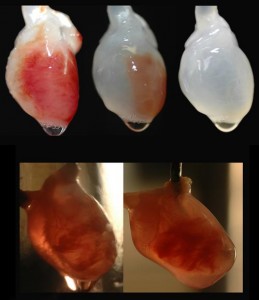
![]() At top, a rat's heart is decellularised until it becomes a scaffold. Stem cells from mice are then applied to the heart, and it is recellularised at bottom. Photo courtesy of University of Minnesota. |
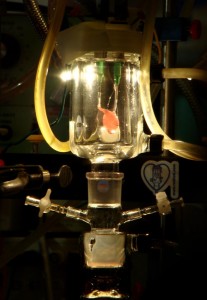
![]() It's alive! This rat heart is being pumped in an artificial structure, allowing stem cells to grow into a new version of the organ. Photo courtesy of the University of Minnesota |
The biggest problem is making sure that each heart grown is fully functioning and able to be transplanted. After being decellularised, each heart has to be recellularised by applying a coating of stem cells and having blood pumped through the heart scaffolding. Along with chemical signals from the scaffold cells, the blood allows the stem cells to specialize into the various needed tissues. Looking at the rat hearts in the pumping machine, it’s hard to believe that you are looking at a living, autonomous organ outside a body. Check out the video from New Scientist:
The ultimate goal, as you would guess, is to radically increase the availability of hearts for transplant in humans. While pig hearts provide a good scaffold, we may see human hearts (from cadavers) as the finalized product. Similar techniques are being used for livers, kidneys, and lungs. Using a patient’s stem cells, and either pig or cadaver scaffolding, doctors may be able to “grow” organs for transplant. Organs where most of the cells share the same DNA as the patient. It’s the ideal situation.
But we are years away from that case at the very least. The University of Minnesota first released information on their research on rat hears back in January 2008. Eighteen months later, and we’re just now seeing pig hearts in various stages of decellularisation. If and when recellularized pig hearts can be transplanted into pigs and keep them alive (the test already passed with rat hearts) we may hear talk about starting human trials. Judging by the slow but steady progress so far, this may be three to five years away. Fortunately, heart transplant patients have some experience with waiting and hoping.
From left to right: A normal pig heart, a pig heart after being decellularised, the pig heart prepared for recellularisation. Photos courtesy of the University of Minnesota.
Tags: decellularised, grow organs, hybrid hearts, organ harvesting, organ transplant, stem cells
Share


Wow that stuff looks straight Mad Science. I approve! Not that I’m not taking care of my heart, but you never know!
[...] Alexander Kruel Stem Cells Used to Grow Hearts: Cool New Pictures and a Video – http://singularityhub.com/2009…; [...]
So how much will one organ replacement cost?
[...] Read the full article at http://singularityhub.com/2009/06/23/stem-cells-used-to-grow-hearts-cool-new-pics-and-vid/ [...]
[...] in the U.S. Perhaps that’s an ignorant reaction. Look at the progress being made in the animal trial stages for organ replacement, or even the madcap use of stem cells in other countries, however, and you get the feeling that [...]
[...] have featured a few stories here on Singularity Hub about growing organs in the laboratory and perhaps this new way of keeping organs alive could be mated to these lab-grown organs. No, [...]
[...] recently Singularity Hub has discussed growing organs, stem cell treatments, and a wide host of bionic body augmentations (even some not so bionic [...]
[...] Here to View Video and Article Adoption Today Magazine Reports Stem Cells in Teeth Open New [...]
How much will it cost you ask? Well if we continue to let the blood sucking insurance companies rule the healthcare world.. It will cost you everything you have and you’ll either pay or die.. Insurance executives love rolling around in blood money.
[...] is. Singularity hub has described how artificial organs may become readily available, including hearts. Imagine a world where we can grow all the kidneys, lungs, or livers we could ever use. The costs [...]
[...] a synthetic model for an organelle may make the more lasting change. We’ve already seen artificial organs, and a whole range of synthetic limbs; progress on the other end of the scale is much rarer. More [...]
[...] a synthetic model for an organelle may make the more lasting change. We’ve already seen artificial organs, and a whole range of synthetic limbs; progress on the other end of the scale is much rarer. More [...]
[...] storing your child’s umbilical cord blood might just save his or her life. With the advent of amazing and clinically tested stem cell treatments, today’s expecting parents are faced with the real [...]
[...] on Singularity Hub, we took a detailed look into the magic of heart replacement surgery (and even growing hearts with stem cells). It’s a great way to tack on a few extra years to patients who are suffering from heart [...]
[...] researchers are making meaningful progress in creating reliable artificial organs, often by utilizing stem cells. China has already made important contributions in the use of stem cells, though some reports are [...]
[...] miraculous. We’ve seen the creation of organs such as the bladder, and even witnessed the beating of an artificially grown heart, but the work at Columbia University is the first development of bone. Slowly but surely, it seems [...]
[...] the development of artificial components of the cardiovascular system. We’ve seen hearts grown from stem cells in labs, artificial mechanical hearts, companies spending millions to develop artificial blood, and [...]
[...] Tuberculosis damaged Claudia Castillo’s lungs and airways. The Colombian mother had such trouble breathing that she was often unable to play with her children or climb stairs. Her left bronchus was narrowing dangerously and some sort of surgery was needed. That’s where Professor Paolo Macchiarini in Barcelona and Professor Martin Birchall in Bristol stepped in. Previous work with pigs had shown that an organ could be stripped down using enzymes and other chemicals. This would leave the organ as nothing but a scaffold. Stem cells could be applied to this scaffold and encouraged to regrow the organ. Singularity hub has discussed similar work done with rat and pig hearts. [...]