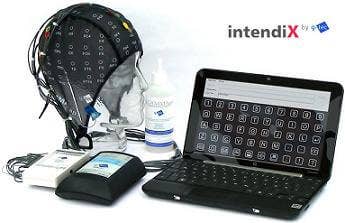
Intendix is the first thought-to-type system you can buy that's ready to use out of the package. BCI is going commercial. About time.
The world’s first patient-ready and commercially available brain computer interface just arrived at CeBIT 2010. The Intendix from Guger Technologies (g*tec) is a system that uses an EEG cap to measure brain activity in order to let you type with your thoughts. Meant to work with those with locked-in syndrome, or other disabilities, Intendix is simple enough to use after just 10 minutes of training. You simply focus on a grid of letters as they flash. When your desired letter lights up, brain activity spikes and Intendix types it. As users master the system, a few will be able to type as quickly as 1 letter a second. Besides typing, it can also trigger alarms, convert text to speech, print, copy, or email. Retailing for €9000 (~$12,250), Intendix isn’t cheap, but it’s the first thought to type system available that’s geared towards easy to setup personal use in the home. Brain computer interfaces just got more accessible, and that’s a step towards them becoming more common all over the world. Check out videos of Intendix after the break.
How commercially available is Intendix? Well they’ve entered the marketing phase where their advertisements don’t actually explain what the product does. I think it took Nike decades to reach that point:
Keyboards and computer mice are only going to take us so far. While some companies are focusing on touchscreens and other next step replacements, the brain computer interface (BCI) is the ultimate I/O device. The ability to directly communicate with machines using our thoughts will allow for greater speed, precision, and intimacy. EEGs, which measure brain activity through the surface of the skin, are a fairly common approach to BCI. We’ve seen them used for typing before, as well as controlling computers, tagging images, or even commanding robots. While Intendix is simply a typing system, g*tec has been working on a Second Life control scheme using the same EEG cap:
EEGs have great temporal resolution for a BCI. This allows Intendix to quickly pick up which letter you are focusing on in a grid by flashing different rows and columns of letters and measuring your brain response. g*tec claims to hold the record for typing speed using an EEG cap as seen in this video of a precursor to the Intendix:
As Kurzweil mentioned in his speech about BCI to the MIT XPrize Lab, EEGs are limited in their applications. They have great temporal resolution, but spatially they lack the precision needed to really translate your thoughts into computer actions in a way that exceeds our current keyboard and mouse system. Eventually, we will need to know more than which centers of the brain are active, we’ll need to know about neocortical columns or even individual neurons. That may mean directly wiring electrodes into the brain. We’ve seen success in that arena already, both with speech and motor controls. Of course, there could be better sensing technology that allows precise spatial and temporal resolution without sticking wires in your head. Projects like the BCI X Prize are aiming to develop them soon.
No matter how the computers of the future will read our thoughts, there’s little doubt that they’ll be communicating directly with our brains. Controlling the digital world will become much more intuitive when we can simply think commands to our devices. With the interconnectivity of social networks and electronic communication, that also means we’ll be able to talk with each other through our thoughts to some degree. The next generation’s Twitter could be broadcasting what we’re thinking. Literally. That level of BCI technology is fairly far off on the horizon, however. Right now we have Intendix; the ability to go to a store, buy a device, and start typing with my thoughts is enough to keep me happy for a while.
[image and video credits: g*tec]
[sources: g*tec, Intendix site]
Tags: bci, brain computer interfaces, CeBIT, control computer with thoughts, EEG, guger technologies, Intendix, thought to type
Share


[...] · Leave a Comment from Singularity Hub: The world’s first patient-ready and commercially available brain computer interface just arrived [...]
SL with BCI? Want!
Hull yes, this looks like the Start Of Something. I'd love one of these, both for virtual world exploring and for chatting on IM programmes… an even flasher and more streamlined way to type than my current shiny shiny keyboard
[...] Intendix, The Brain Computer Interface Goes Commercial (video) (singularityhub.com) [...]
[...] Intendix, Tһе Brain Computer Interface Goes Commercial (video … [...]
[...] more from the original source: Intendix, The Brain Computer Interface Goes Commercial (video … AKPC_IDS += "3005,";Popularity: unranked [?] Share and [...]
[...] Intendix, The Brain Computer Interface Goes Commercial (video) | Singularity Hub [...]
Large scale mapping of neuronal circuits will help with BCI resolution. This project will be done within the next 10-15 years.
What are the constraints that only allow for one letter per second?
This is AWESOME! I have a friend with Parkinson's who would greatly benefit from this …
[...] Singularity Hub: Intendix, The Brain Computer Interface Goes Commercial [...]
[...] Intendix, The Brain Computer Interface Goes Commercial (video) | Singularity Hub [...]
[...] Singularity Hub and The Stranger [...]
This is just guessing from what I saw in the video, but it looks like the typing simply uses a single action 'click' type equivalent, where there is an impulse detected when the user wants to 'click'. The speed limitation comes from the row/column highlight and how quickly it can flash through those and the user can select when the right ones are lit up.
What they should do is hook this up with an eye tracker, then the users gaze can be taken as a pointer and the impulse as a selection. Then with a bit of training you should be able to type as fast as you can look at the letters.
This is great but Stop talking telepathy and start talking telekinesis! Have you seen the video of the monkey feeding himself with the robot arm while the locked-in folks are poking at your fancy keyboard?
[...] Intendix will be the first patient-ready commercially available brain-computer interface. Designed to help those who have little to no motor function. Patients will be able to type at about 60 letters per minute and should be able to click various buttons to send email, etc. This technology is to be sold for approximately $12 250. [Singularity Hub] [...]
[...] Letter Per Second Posted in bci , metavalent , posthuman , substrate independence0 comments Singularity Hub reporting: The world’s first patient-ready and commercially available brain computer interface just arrived [...]
[...] wearable brain computer interface. And for only 9000E, you can type by [...]
[...] Permalink Singularity Hub | Intendix | Email this | Comments Posted in Tech News Tags: braincomputer, consumers, GTec, Intendix, interface, ready, video « NEW Apple iPAD Commercial – 2/10/10 Apple Universal Dock Adapter 3-Pack for 20 GB and 30 GB iPod 4G, U2 iPod » You can leave a response, or trackback from your own site. [...]
[...] Permalink Singularity Hub | Intendix | Email this | Comments [...]
[...] Permalink Singularity Hub | Intendix | Email this | Comments [...]
[...] Permalink Singularity Hub | Intendix | Email this | Comments Share News Lenovo IdeaPad S10-3t review Target launches first scannable mobile coupon program, frugalistas going wild [...]
[...] Permalink Singularity Hub | Intendix | Email this | Comments [...]
[...] on Engadget on Wed, 10 Mar 2010 11:19:00 EST. Please see our terms for use of feeds.Permalink Singularity Hub | Intendix | Email this | Comments Tags: brain-computer [...]
[...] Permalink Singularity Hub | Intendix | Email this | Comments [...]
[...] Permalink Singularity Hub | Intendix | Email this | Comments ArrayArrayArrayArrayArrayArray Link To This Post1. Click inside the codebox2. Right-Click then Copy3. Paste the HTML code into your webpage codebox<a href="http://www.touchtotech.com/g-tec-intendix-brain-computer-interface-ready-for-consumers-video/2010/03/10/">G-Tec Intendix brain-computer interface ready for consumers (video)</a> Related PostsNo Related Post [...]
[...] Permalink Singularity Hub | Intendix | Email this | Comments [...]
[...] world’s first commercial effort at a patient-ready brain computer interface is on display over at CeBIT 2010, but don’t go [...]
[...] в мире коммерческий проект по созданию готового к использованию мозгового [...]
[...] world’s first commercial effort at a patient-ready brain computer interface is on display over at CeBIT 2010, but don’t go [...]
[...] Ray Kurzweil and other futurists have made the same prediction, and we’ve already seen the first patient-ready brain computer interface get ready to go on sale. It seems increasingly likely that our brain will be able to directly interact with machines via [...]
[...] [via singularityhub] [...]
[...] Intendix: world’s 1st commercially available brain computer interface – lets you type with y… [...]
[...] world’s first commercial effort at a patient-ready brain computer interface is on display over at CeBIT 2010, but don’t go [...]
Intendix, The Brain Computer Interface Goes Commercial…
Thank you for submitting this cool story – Trackback from CodingFuture…
[...] world’s first commercial effort at a patient-ready brain computer interface is on display over at CeBIT 2010, but don’t go [...]
[...] hackers everywhere have already started to improve upon the design. We just saw the release of the first patient-ready BCI on the market. Maybe with that EEG they’d be able to do something more productive than shock you. As brain [...]
[...] Intendix, la première interface cognitive pour tous – Singularity Hub [...]
[...] The computerized clothing of the future is going to let everyone personalize their style and improve their lives. Not only will we have shirts that can change at the touch of a switch, we’ll have clothes that serve a purpose. Socks that tell us when we need to take a load off our feet, shirts that monitor our hearts, jackets that never let us get lost, hats that soothe our headaches with gentle massages…it’s all coming down the pipeline, folks. Those who want to become a fashion mogul of the future should start thinking about getting an electrical engineering degree. In the meantime, I’m saving up for some electrodes and a sewing machine. I’m pretty sure I can make a propeller beanie that reads your mind. [...]
[...] with many monetary, and academic prizes on the line. Preliminary interfaces already exist for mind-mail, gaming, and a few other things. This is clearly a growing development industry, and targeting [...]
[...] Singularity Hub and The Stranger [...]
[...] The rest is here. « Neuroplasticity … [...]
[...] the cutting edge of physics, his speaking technology really isn’t. We’ve already seen spelling systems that don’t require any muscle movement at all, but instead rely entirely on E…. There are even systems which can directly embed electrodes in the brain and allow you to choose [...]
[...] you dismiss the piper’s dream of computer interaction through thought, read this, this and this. It is being considered and actively researched, because Brain-Computer Interfacing will be a [...]
[...] brain activity into meaningful insight about emotions and behavior. Surface scanning devices, EEGs, have gone commercial – mainly as means for the paralyzed to communicate, but with a wide range of novel [...]
[...] Singularity Hub [...]