Sci-Fi Short “Lost Memories 2.0” Weighs the Price of the Digital Life
Share
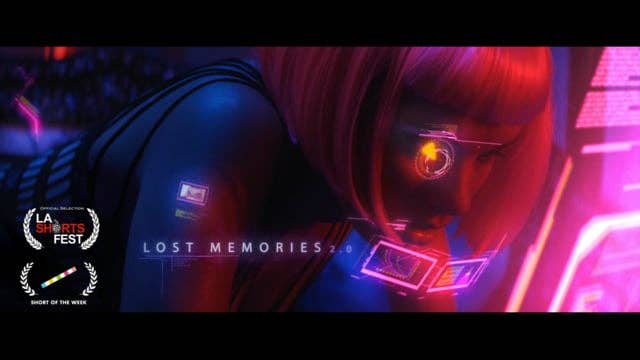
"In your virtual world, everything is smooth." — from Lost Memories 2.0
In our Digital Age, we are experiencing the coming together of physical and digital worlds. Yet, it is still unclear whether this convergence will be more harmonious unification or head-on collision.
No technology helps us to envision how these two realms come together like augmented reality. Even in its infancy, AR prototypes like Google Glass drew enormous interest in their immersive potential but also scorn in the form of calling obnoxious wearers "glassholes".
How might our lives and relationships be affected when AR technology matures years from now? Will we become addicted?
In 2012, the short film Lost Memories was released to show a relationship divided by the intersection of these two worlds. In the film, "The Cloud" is a AR information layer covering every natural surface like wallpaper and providing an overwhelming amount of head-up interfaces. That is, until it collapsed, leaving digital natives afloat in an unfamiliar environment.
Be Part of the Future
Sign up to receive top stories about groundbreaking technologies and visionary thinkers from SingularityHub.

Recently, director Francois Ferracci released the longer sequel Lost Memories 2.0 with a return to the protagonist after the cloud was rebooted. It's a future where the permeation of digital information will be so thick that it will distract even the most intimate of moments. This gritty (and somewhat NSFW) short serves to both amaze and warn of just how artificial we may become in an augmented reality that knows no limits.
It's worth noting that the theme of technology, memory, and loss was also depicted beautifully in a 2014 sci-fi short, Memories 2.0. Hopefully one of these ideas can get greenlit for a feature film.

Related Articles
Google DeepMind Gives AI-Designed Proteins a Watermark
US Launches $215 Million Race to Build an Error-Corrected Quantum Computer by 2028
How Would AI Actually Kill All Humans? Here Are the Top 5 Scenarios
Google DeepMind Gives AI-Designed Proteins a Watermark
US Launches $215 Million Race to Build an Error-Corrected Quantum Computer by 2028
How Would AI Actually Kill All Humans? Here Are the Top 5 Scenarios
What we’re reading