Vuzix Makes Head Mounted Display Easy with iWear CamAR
Share
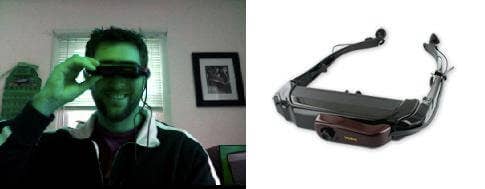
Augmented Reality may be the artistic medium of the future. We've already seen AR in large corporate displays, video games, smart phone applications, and at tourist sites. Producing a realistic AR simulation requires a camera, a viewing screen, and a bunch of time creating digital images. Most of the time, the camera and screen are far from one another, but there's a better way of doing things. Head mounted displays (HMDs) look like elaborate goggles and contain the camera and screens all in one small system. Vuzix is now offering an AR HMD system for just $500, not a bad price for the amateur developer. Check out the work of one such programmer, Craig Kapp, using Vuzix hardware in the video after the break.
Craig Kapp (right) used Vuzix's new HMD (right) to create an AR demo.
The HMD system is the iWear CamAR (essentially an USB webcam) that attaches to Vuzix's VR920 goggles. Respectively they retail for $150 and $400, but you get a $50 break when ordering them together. While it's not open source, the CamAR doesn't require any special drivers or API to operate and Vuzix will offer developers free access to SDKs upon request. While it takes a certain level of expertise to create virtual items to be view in the AR environment, I hope that the low cost of this HMD system will encourage many to take up AR as a hobby. A flood of amateur productions could help move AR systems firmly into mainstream media. From there, I'm sure it will start to dominate the way we interact with our digital and real-world environments. One day we may all be wearing AR contact lenses that feed us a constant stream of information about the people, places, and things around us. Until then, save up your cash so you can enjoy goggles that let you see things that aren't there.
Be Part of the Future
Sign up to receive top stories about groundbreaking technologies and visionary thinkers from SingularityHub.

Craig Kapp is a student at the Interactive Telecommunications Program (ITP) at NYU. Check out his blog.
[photo credit: Craig Kapp, Vuzix]

Related Articles
These Mini Brains Just Learned to Solve a Classic Engineering Problem
Brain Implants Let Paralyzed People Type Nearly as Fast as Smartphone Users

Hackers Are Automating Cyberattacks With AI. Defenders Are Using It to Fight Back.
These Mini Brains Just Learned to Solve a Classic Engineering Problem
Brain Implants Let Paralyzed People Type Nearly as Fast as Smartphone Users
Hackers Are Automating Cyberattacks With AI. Defenders Are Using It to Fight Back.
What we’re reading