Robotic Arm Opens Doors for Wheelchairs (Video)

Share
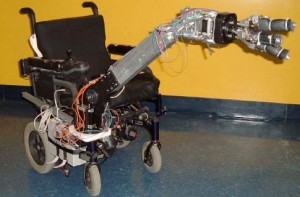
If good help is hard to find, consider building it instead. Opening doors isn't any easy task for robots, they have to adjust to each new kind of latch. Yet one researcher from the University of Massachusetts at Lowell has created a robotic arm that can tackle more than a dozen different kinds of knobs with great success. Erin Rapacki built the Door Opening Robot Arm (DORA) for around $2000, considerably cheaper than similar models. Part of what makes DORA so remarkable, is that the machine works without any cameras or sensors, relying only on a planetary gearbox to control gripping. DORA was presented early in November at the IEEE conference Technologies for Practical Robot Applications (TePRA) and you can see it in action in a video from New Scientist after the break.
With just one motor, DORA is able to close its grip and twist the doorknob all in the same motion. A slip clutch allows the hand to twist even as the arm pushes or pulls the door open. Rapacki's success with the robot bodes well for an eventual production model: of 14 different knobs tested, DORA had a 85% success rate for push doors and a 65% success rate for pulls. Of course, DORA is largely human aimed even if it is automated, and can't really be compared with the door opening prowess of a robot like Willow Garage's PR2. Still, for a wheelchair bound individual the device could certainly come in handy. Rapacki has moved on from UMASS Lowell to Anybots, so it's unclear if DORA will make it to market. Yet the project has certainly proven that many tasks which can be adapted to robotics need not be adapted to artificial intelligence. Sometimes a simpler approach makes more sense economically.
Be Part of the Future
Sign up to receive top stories about groundbreaking technologies and visionary thinkers from SingularityHub.

https://c.brightcove.com/services/viewer/federated_f9/2227271001
[photo credit: E. Rapacki, UMASS Lowell]
[video credit: New Scientist]

Related Articles
This ‘Machine Eye’ Could Give Robots Superhuman Reflexes
This Robotic Hand Detaches and Skitters About Like Thing From ‘The Addams Family’
Waymo Closes in on Uber and Lyft Prices, as More Riders Say They Trust Robotaxis
This ‘Machine Eye’ Could Give Robots Superhuman Reflexes
This Robotic Hand Detaches and Skitters About Like Thing From ‘The Addams Family’
Waymo Closes in on Uber and Lyft Prices, as More Riders Say They Trust Robotaxis
What we’re reading