Augmented Reality Makes Walls Transparent (Video)

Share
Researchers at Carnegie Mellon University are going to bring you Superman's X-ray vision. Using multiple cameras and new video transformation software, the CMU team can let you see through a wall in a specialized form of augmented reality. The image from the camera behind the wall is skewed so that it makes sense from your perspective in front of the wall. The result is a seamless transfer from one side of the wall to the other, making it look transparent. Developed by Takea Kanade , Ankur Datta, Peter Barnum, and Yaser Sheikh, the system was debuted at the 2009 International Symposium on Mixed and Augmented Reality (ISMAR). They hope their work would allow car drivers to avoid dangers hidden around the corner of a building. Seeing this thing in action, it's just incredible. I think these developers have created another exciting example of why augmented reality is going to be a defining motif for technology in the years to come. Check out the video from New Scientist after the break.
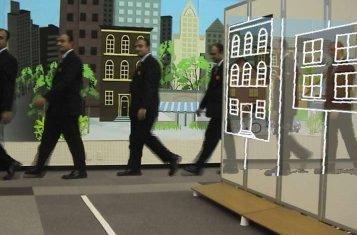
The team has created several simulations, including a live test run that operates at 5 Hz (essentially refreshing camera images five times per second). However, this technology has several major hurdles to clear before you could take advantage of it. First is camera connectivity. You would need to not only have a camera on your person (or car) but also cameras with views behind every relevant wall. And you would need the system to have wireless access to all of them. For London and its extensive CCTV coverage that wouldn't be a problem but most cities aren't so equipped. You would also need some sort of display screen. A projection system, like those made by Light Blue Optics, would be necessary to let a driver see through the transparent wall without having to stare at a video monitor on the dashboard.
Be Part of the Future
Sign up to receive top stories about groundbreaking technologies and visionary thinkers from SingularityHub.

https://c.brightcove.com/services/viewer/federated_f9/2227271001
The system may work very well in an indoor area like a hospital. Nurses could watch patients on monitors as they rounded "dangerous" corners, or were occluded by equipment. Eventually, we'll have so many surveillance cameras all around us that the CMU technology could become a very useful tool. Certainly it could augment security systems like the Samurai Project. Guards wearing video glasses could see what was happening behind walls all the way to the other side of the building. For that matter, a system like this could eliminate the term "obstructed view" from all sports arenas and theatres. Ordinary humans are becoming more of a match for Superman every day through the use of science and technology. Lex Luthor would be proud.
[photo credit: Peter Barnum, Carnegie Mellon]
[video credit: New Scientist]

Related Articles
How Scientists Are Growing Computers From Human Brain Cells—and Why They Want to Keep Doing It

These Brain Implants Are Smaller Than Cells and Can Be Injected Into Veins
This Wireless Brain Implant Is Smaller Than a Grain of Salt
How Scientists Are Growing Computers From Human Brain Cells—and Why They Want to Keep Doing It
These Brain Implants Are Smaller Than Cells and Can Be Injected Into Veins
This Wireless Brain Implant Is Smaller Than a Grain of Salt
What we’re reading