Could Implanted Pellets Replace Booster Shots?
A small pellet could be implanted under the skin along with an injected vaccine; later, instead of a booster shot, a pill taken orally would signal the pellet to release a second dose, researchers at the University of Freiburg demonstrated in a recent paper.

Share
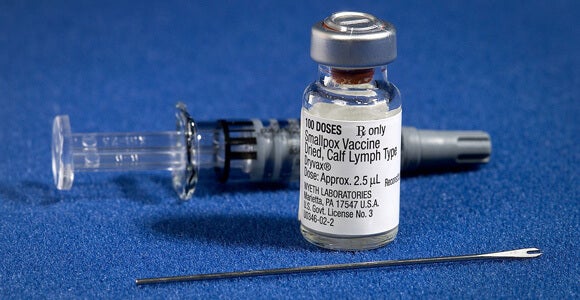
The belief among some parents groups that vaccines are bad for children might best be explained as a result of parents’ discomfort watching their children cry as they are stuck with a needle. It can be hard to adhere to the abstractions of science when faced with a child’s tears.
Well, what if doctors could deliver a no-tears vaccine? That’s what some researchers at the University of Freiburg, in Germany, are working toward. In a recent paper, they demonstrated that a small pellet could be implanted under the skin along with an injected vaccine. Later, instead of a booster shot, a pill taken orally would signal the pellet to release a second dose.
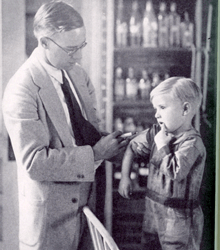
Eliminating all booster shots would reduce the number of shots babies get by two-thirds, according to CDC recommendations.
And in developing countries, patients could be sent home with instructions to take the signal pill at a certain time, improving compliance.
Be Part of the Future
Sign up to receive top stories about groundbreaking technologies and visionary thinkers from SingularityHub.

The researchers used a pellet made of hydrogel, a polymer similar in texture to human tissue, to hold the second dose. This particular hydrogel was formulated to respond to fluorescein, an organic compound which is already FDA-approved for use in humans. An oral dose of fluorescein stimulated the pellet to release its vaccine payload.
A booster dose of a vaccine against the human papillomavirus delivered this way was as effective in mice as one injected.
More research is needed before the Russian nesting doll-styled vaccine cycles make it to the pediatrician’s office. But with a functional vaccine and a trigger that’s already been approved, the method seems likely to work for humans with some adjustments.
Images: James Gathany, CDC via Wikimedia Commons; Commonwealth Fund via Wikimedia Commons

Related Articles

We May Be Wrong About How the Brain Stores Memory

Long Foreseen, the Problem of AI Alignment Is Finally Reality. Solving It Won’t Be Easy.

Scrapping a New Gas Car for an Electric One Could Cut Emissions, Study Finds
We May Be Wrong About How the Brain Stores Memory
Long Foreseen, the Problem of AI Alignment Is Finally Reality. Solving It Won’t Be Easy.
Scrapping a New Gas Car for an Electric One Could Cut Emissions, Study Finds
What we’re reading