Mini Human Organs Just Got Much Closer to Matching the Real Thing
New models could shed light on early human development and be used for drug discovery and tissue transplants.
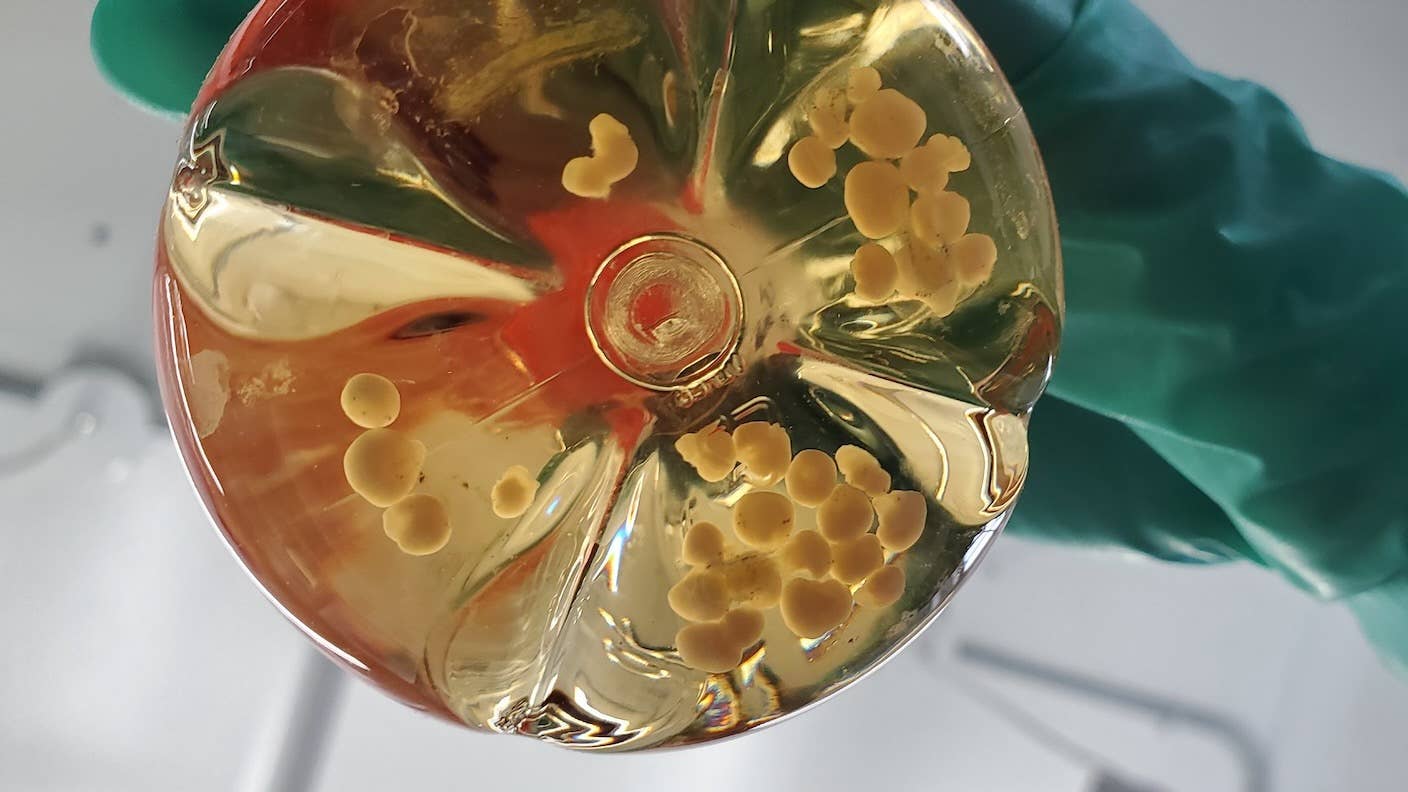
Image Credit
Mini brains in a flask. Credit: NIAID
Share
Miniature organs have a new lifeline. Mimicking the way early human embryos grow blood vessels, scientists nudged multiple types of mini organs to sprout their own vascular networks.
Also called organoids, mini organs capture the intricacies of their natural organ counterparts, including how they grow, communicate, and function. This makes them perfect for research into genetic diseases and testing new drugs. Mini brains, for example, have already shed light on glioblastoma, a deadly brain cancer, and decoded how the brain controls muscles.
Organoids can also help parse genetic and developmental disorders. They carry the same genes as their donors—mini organs are often developed from skin cells—and can mimic a wide range of inherited diseases. They’re especially useful for charting the first stages of human development and can help tease out when and where things go wrong.
Despite their potential, mini organs have been haunted by one problem: They don’t have circulation. Without vessels to provide oxygen and nutrients and to wash waste away, mini organs can only develop so much. Over time, their core eventually dies, and they wilt away.
By analyzing mini organs and teasing out the genes and proteins involved in making vessels, the teams behind two new studies discovered multiple chemical cocktails to spur mini hearts, livers, lungs, kidneys, and intestines to naturally sprout forests of blood vessels.
Thanks to a steady infusion of nutrients, the upgraded organoids grew into some of the most complex mini organs to date. They developed structures and cells never seen before in the lab.
The techniques are likely universal and could generate other mini organs with blood vessels.
A Bloody Problem
Blood is often called the “elixir of life” for good reason: It nourishes the whole body with the delivery of oxygen and nutrients. Cut off blood supply, and most organs fail.
Organoids are the same. These mini organs usually begin life as skin cells, which are then chemically transformed into a stem-cell-like state. Protein cocktails nudge these cells into a variety of mini organs over the course of a few weeks gently churning in a bioreactor.
With the right concoction, the stem cells automatically form intricate 3D structures, such as mini brains resembling the second trimester of human fetal brain development. These organoids have similar types of brain cells to their natural counterparts distributed throughout and spark with electrical activity. Some even pump out anti-stress hormones when implanted into mouse brains, suggesting they might one day replace damaged tissues.
But lack of blood supply limits organoid development. There are already a few solutions. One is to embed organoids and endothelial cells—cells that line blood vessels—into a gel so both cell types develop together. Another uses 3D bioprinting to “write” vessel networks into small nubs of liver and heart organoids. Though they’re promising, both methods add complexity.
Humans, in contrast, automatically develop blood vessels that weave around and inside our organs as we develop in the womb. Why not recreate that process in a dish?
Pumping Blood
As an embryo develops, it separates into layers, each of which eventually transforms into a different organ. Blood vessel and heart cells originate in a layer called the mesoderm.
In one of the new studies, a Stanford team created glow-in-the-dark human stem cells in three colors to mark different types of heart and blood vessel cells. They made a pool of baby cardiovascular cells—which could become both heart and vessel cells—and added a cocktail of molecules and proteins, or growth factors, to nudge these into a heart with blood vessels.
Be Part of the Future
Sign up to receive top stories about groundbreaking technologies and visionary thinkers from SingularityHub.

Previous studies found that micropatterning—the precise placement of induced stem cells onto a surface—can optimize how organoids grow. The team tested nearly three dozen formulations to transform them into mini hearts. One eventually spurred the stem cells to form and combine both heart muscle cells and vessel cells into a cohesive structure in roughly a week.
Within 12 days, the mini heart resembled that of a human fetus about three weeks after conception. Blood vessels integrated into heart muscle cells, forming intricate branches that spread throughout the mini heart. These kept expanding in size as the organoids grew. The vascularized hearts showed normal electrical activity and played a consistent beat of roughly 50 pulses per minute, which is roughly similar to donated human fetal heart tissue in culture.
The team next found two molecular pathways that shut down blood-vessel development. Both involved multiple protein “signatures” that changed over time as the organoids developed. The team fine-tuned their organoid recipe to favor vessel growth.
The new recipe worked to develop more than just heart organoids. The team also used it to create a mini liver innervated with blood vessels.
That the same combination of factors worked on both suggests that different organs have a “conserved developmental program,” wrote the authors. The method, then, might be used to create other organs with vessels.
Balancing Act
Another study, led by scientists from the University of Cincinnati College of Medicine and collaborators, took a different approach. Using a technology called RNA-seq, they recorded which genes were active in lung and gut organoids. This led them to discover a protein called BMP that fine-tunes mini-organ development to allow the growth of healthy blood vessels with both endothelial cells—the blood-vessel liners—and other muscle cells that help them contract.
The two cell types are usually at odds during development, each requiring a different type of molecular trigger at a specific stage. BMP is like a switch to toggle between the two states. By carefully timing the switch, the team generated both cell types in parallel.
They used this technique to make a mini lung with vessels. Spread on a 3D scaffold, the organoids spontaneously assembled into structures similar to gas-exchanging alveolar sacs in the lung. The team transplanted these into mice and found they integrated with each host’s blood supply and boosted the mini lung’s size and health. They also used the method to craft vascularized mini guts, which could be used to test drugs for celiac disease and other gut-related issues.
Both studies are examples of the latest push into more sophisticated organoids. “Vascularization of organoids is a hot topic,” Ryuji Morizane at Massachusetts General Hospital to told Nature.
The next step will test if the vessels can circulate blood outside a living host. If they can, organoids could finally live up to their potential as vehicles for research, drug development, and on-demand replacement of damaged tissues.

Dr. Shelly Xuelai Fan is a neuroscientist-turned-science-writer. She's fascinated with research about the brain, AI, longevity, biotech, and especially their intersection. As a digital nomad, she enjoys exploring new cultures, local foods, and the great outdoors.
Related Articles
Souped-Up CRISPR Gene Editor Replicates and Spreads Like a Virus

Your Genes Determine How Long You’ll Live Far More Than Previously Thought
Google DeepMind AI Decodes the Genome a Million ‘Letters’ at a Time
Souped-Up CRISPR Gene Editor Replicates and Spreads Like a Virus
Your Genes Determine How Long You’ll Live Far More Than Previously Thought
Google DeepMind AI Decodes the Genome a Million ‘Letters’ at a Time
What we’re reading