Google Will Store Energy in Giant Domes Filled With CO2
Energy stored in liquid CO2 is converted back into gas to turn turbines on demand.
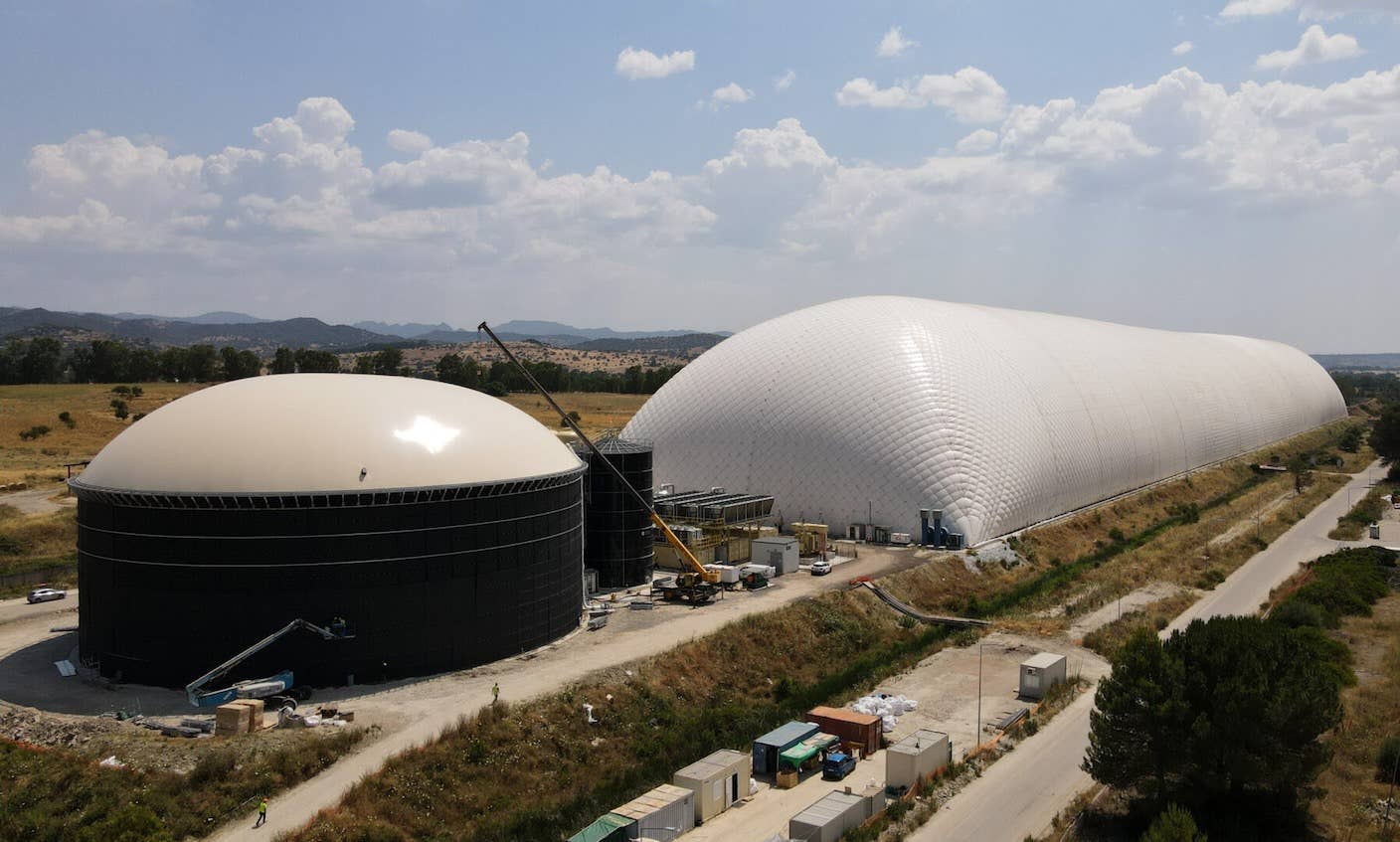
Image Credit
Energy Dome's CO2 battery / Energy Dome
Share
Tech companies are throwing money at new sources of energy, from wind and solar to next-generation geothermal, nuclear, and even fusion power. But all that electricity isn’t good for much unless it can be stored then dispatched on demand, particularly for intermittent sources like wind and solar. An Italian company called Energy Dome has a novel solution, and recently signed a contract with Google to build multiple energy storage facilities for the tech giant.
Energy Dome’s battery uses carbon dioxide (CO2) to store energy in liquid form when electricity supply is high, then releases energy when supply is low by converting the liquid CO2 back to a gas, spinning a turbine in the process.
The technology is a form of compressed air energy storage, which has been around since the late 1970s when the first utility-scale facility was built in Germany. Energy Dome puts a new twist on conventional systems by using CO2 instead of regular air. Despite being vilified for our climate change woes, it turns out the greenhouse gas carries some benefits when it comes to energy storage. It has a higher energy density than air, and it liquefies at ambient temperatures under pressure.
Here's how Energy Dome’s process works. CO2 is stored as a gas in a giant dome. When energy is cheap and abundant—namely, when the sun is shining and the wind is blowing—the gas is pumped into a compressor, where it gives off heat (which is stored) and turns into a liquid that’s stored in carbon steel tanks. When the sun sets or wind dies down but people still want to run their air conditioners or query ChatGPT, an evaporator uses the stored heat to turn the liquid CO2 into pressurized gas, which shoots out like steam from a pressure cooker, turning turbines and generating electricity.
Lithium-ion batteries are the go-to for storing electricity produced by wind and solar farms, but the batteries can only release electricity for a few hours at a time. Their maximum continuous dispatch time over the last several years has been four hours, and recent advancements could bring that up to eight hours. But that’s still not long enough to satisfy demand if the sun stops shining for days.
Energy Dome’s CO2 battery is considered a long-duration energy storage (LDES) solution. LDES is defined as a storage system that can deliver electricity at a consistent rate for 10 hours or more. The company says its CO2 battery can dispatch energy for up to 24 hours. And since the liquid CO2 can be stored at ambient temperature, it takes up less space and is more energy-dense than conventional compressed air energy storage (though the “dome” itself isn’t exactly petite). Paolo Cavallini, the company’s founder, says the CO2 batteries “can last 30 years without any kind of degradation.”
The approach is promising. But there may be engineering challenges to get it working as hoped. For example, Edward Barbour, an associate professor of energy systems and storage at Birmingham University, told MIT Technology Review in 2022 that keeping the heat exchangers in working order for decades may be tough.
Be Part of the Future
Sign up to receive top stories about groundbreaking technologies and visionary thinkers from SingularityHub.

Energy Dome has a commercial-scale plant up and running in Italy, which was funded by the Bill Gates-backed Breakthrough Energy and the European Investment Bank. The facility has a 20-megawatt capacity and a 10-hour cycle. The company says it can power 14,000 homes (that’s Italian homes, which consume less energy than American ones).
Google has not disclosed financial details of its agreement with Energy Dome, but the tech giant did state in a press release that it plans to support commercial projects in several different countries, and believes these projects “can unlock new clean energy for grids where we operate before 2030.”
The company isn’t the only one betting on CO2 batteries. The Department of Energy gave a $30 million grant to Alliant Energy to build the Columbia Energy Storage Project in Wisconsin, which is licensing Energy Dome’s technology.
Electricity demand is only going to rise over the next several years, but building new generation to meet that demand is just one piece of the puzzle. Storage is another, and it seems Energy Dome is well-positioned to help fill that gap.

Vanessa has been writing about science and technology for eight years and was senior editor at SingularityHub. She's interested in biotechnology and genetic engineering, the nitty-gritty of the renewable energy transition, the roles technology and science play in geopolitics and international development, and countless other topics.
Related Articles
The Mad Scramble to Power AI Is Rewiring the US Grid
US Solar Surged 35% in 2025, Overtaking Hydro for the First Time
Meta Will Buy Startup’s Nuclear Fuel in Unusual Deal to Power AI Data Centers
The Mad Scramble to Power AI Is Rewiring the US Grid
US Solar Surged 35% in 2025, Overtaking Hydro for the First Time
Meta Will Buy Startup’s Nuclear Fuel in Unusual Deal to Power AI Data Centers
What we’re reading