Single CAR T Injection Eases Multiple Sclerosis Symptoms in Small Trial
A potentially safer, simpler way to create CAR T cells in the body could bring this powerful therapy to the masses.
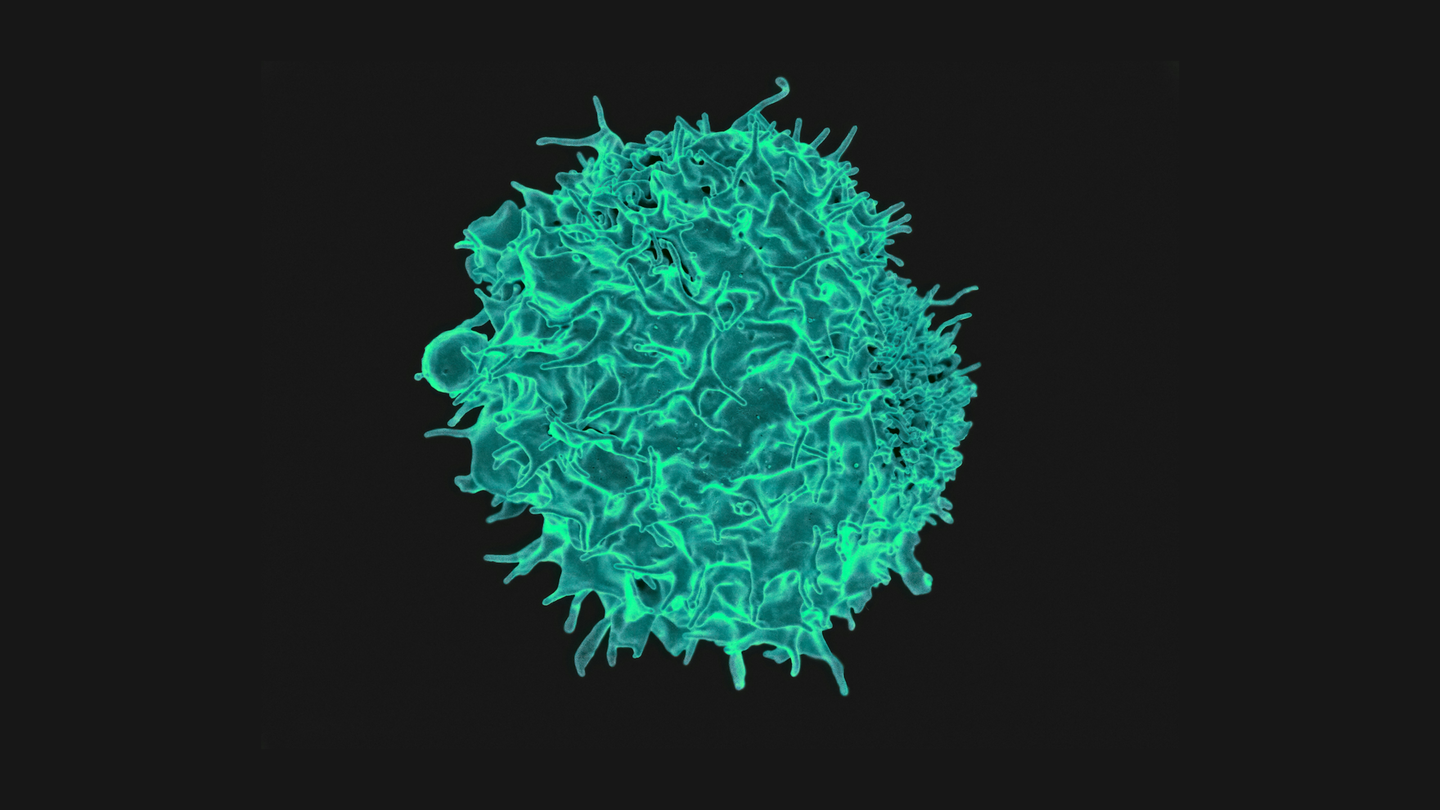
Image Credit
Colorized image of a T cell / NIAID
Share
When the body goes to war on itself, it wreaks havoc.
The immune system is one of our most powerful defenses, protecting us from infections, cancer, and other threats. But it’s a double-edged sword. Sometimes all that firepower is turned against healthy tissue. The resulting autoimmune diseases can be devastating. Take multiple sclerosis, an insidious disease that gradually eats away at the insulating coating around delicate nerve fibers, scrambling the electrical signals that control our bodies. The disease often strikes in young or middle adulthood, and there’s no cure.
Now a new clinical trial turns the immune system’s arsenal against the cells driving the autoimmune attack. Called CAR T cell therapy, the approach has already had success tackling previously untreatable blood cancers. Normally, CAR T cells are isolated and genetically engineered in specialized facilities. But in the new trial, with a single injection, researchers delivered a virus carrying genetic instructions to reprogram T cells in the body.
In 16 patients with autoimmune disorders affecting the nervous system, the treatment had few severe side effects. It also seemed to hit a kind of immune reset button. Follow-up tests suggested that the treatment restored parts of patients’ immune systems to normal, and there were no signs the friendly fire had returned. Across three different diseases, symptoms and molecular markers improved for over six months.
“These findings provide proof-of-concept that in vivo [in the body] CAR T-cell generation is associated with manageable side effects and may be effective for treating refractory neurologic autoimmune disorders,” wrote the team.
The study was small, and there was no control group. But it brings the dream of a simpler, cheaper, and more affordable CAR T therapy a step closer. This could, in turn, give more people access to the drug.
“It’s a clear go signal for a further study,” Georg Schett at University Hospital Erlangen, who wasn’t involved in the work, told Science.
Outside In
Once a niche treatment for blood cancer, CAR T therapy has quickly expanded, with over 1,500 clinical trials registered worldwide. Hope is high CAR T can battle solid tumors, which account for more than 85 percent of cancer cases, and even stop them from spreading. It’s also being repurposed to take on a range of autoimmune disorders, such as lupus, with promising early results.
But there’s a catch. Making CAR T cells is a logistical nightmare.
Traditionally, doctors must harvest a patient’s T cells and genetically edit them outside the body to produce protein “bloodhounds” called chimeric antigen receptors, or CARs. These proteins sit on each engineered cell’s surface and help it recognize a specific target. Once CAR T cells are infused back into the patient, they hunt down and attack disease-causing cells involved in some cancers and autoimmune disorders.
The whole production can take weeks—precious time some patients don’t have. A price tag in the hundreds of thousands of dollars keeps the therapy out of reach for many. And the need for toxic chemotherapy, which clears out existing immune cells to make room for CAR Ts, leaves people vulnerable to infection and adds another burden to an already grueling treatment.
So, researchers have pursued shortcuts. One idea is to skip the individualized manufacturing step and use healthy donated T cells to save time and cost. But this can trigger immune rejection, where the body wipes out the “invaders,” or spark dangerous reactions against the patient’s own tissues.
These risks aren’t just speculation. The pharmaceutical giant Novartis recently halted eight CAR T trials for autoimmune disorders after three participants died from a severe inflammatory complication. While the tragedy is still under investigation, one possible cause is that the engineered cells expanded and activated too rapidly.
In another popular alternative, researchers alter a patient’s own T cells inside their body. Dubbed in vivo, this method delivers a synthetic gene encoding the CAR protein to T cells, turning them into super-soldiers on the spot. In theory, the same genetic formulation could work for many people, making CAR T therapy more like a drug and slashing time and cost. The approach also spares patients from chemotherapy and could be safer.
But it’s tricky business. Transforming isolated T cells outside the body limits the added gene to only that population. Inside the body, scientists have far less control over where the genetic cargo goes. A delivery system meant only for T cells could reach other cell types or inadvertently integrate into the genome, spurring mutations that contribute to cancer. Still, some creative workarounds that boost safety and efficacy have already shown promise in mice.
Be Part of the Future
Sign up to receive top stories about groundbreaking technologies and visionary thinkers from SingularityHub.

But what about people?
Factory Reset
The new trial recruited 16 volunteers with multiple sclerosis and other autoimmune conditions affecting the nervous system, including diseases that attack the spinal cord or eyes or cause muscle weakness.
Led by Dai-Shi Tian of the Huazhong University of Science and Technology, the team infused patients with a virus carrying instructions to turn T cells into CAR T cells that would go on to target rogue B cells. The latter are immune cells that pump out autoantibodies against healthy tissue. Patients were monitored for six months, with safety as a priority.
None developed severe nerve inflammation, a potentially deadly CAR T complication. The treatment briefly revved up inflammatory molecules in 11 participants, but the response was manageable and faded after roughly two weeks.
Because the virus inserts DNA into the genome, the team also tracked where the synthetic gene landed. Most copies of the gene were found in regions that don’t encode proteins. But these parts can still influence gene activity, and it’s too soon to conclude the therapy is safe over the long term—or that it works.
Still, early signs are promising. After one infusion, patients continued producing CAR T cells for months, while levels of disease-causing B cells plummeted. The immune system seemed to reset. Newly generated replacement B cells no longer made autoantibodies, hinting the effects might last.
Symptoms also improved. People with multiple sclerosis reported less fatigue and better motor and cognitive function. Molecular markers of nerve injury fell, and none of the patients developed new damage to the protective sheaths around their nerves. Those suffering from other neurological autoimmune conditions that weaken muscles regained strength, had lower levels of inflammation, and reported better quality of life.
The findings add to growing evidence that in vivo CAR T may work in people. Previous small trials have already tested it against cancer and lupus, with encouraging results.
If the findings hold up in more people, the treatment “could be a gamechanger,” David Simon at Charité–Universitätsmedizin Berlin, who wasn’t involved in the study, told Nature. “This is a very exciting proof-of-concept study.”
The team cautions that more follow-up is needed to see how long the benefits last and catch delayed side effects, such as cancer or infections. And because autoimmune diseases are chronic, relapse remains a concern. They plan to launch a larger trial focused on a single condition, potentially with a control group.

Related Articles

Blind Patients Recover Partial Vision in Gene Therapy Trial

The Evolving Quest to Build Life in a Lab
Radical New Tactic Would Stop Deadly Cancers Before They Start
Blind Patients Recover Partial Vision in Gene Therapy Trial
The Evolving Quest to Build Life in a Lab
Radical New Tactic Would Stop Deadly Cancers Before They Start
What we’re reading