AI Agents Ran a Biology Lab. Humans Popped in to Empty the Trash.
"Self-driving" labs could free scientists to analyze results, refine hypotheses, and brainstorm ideas.
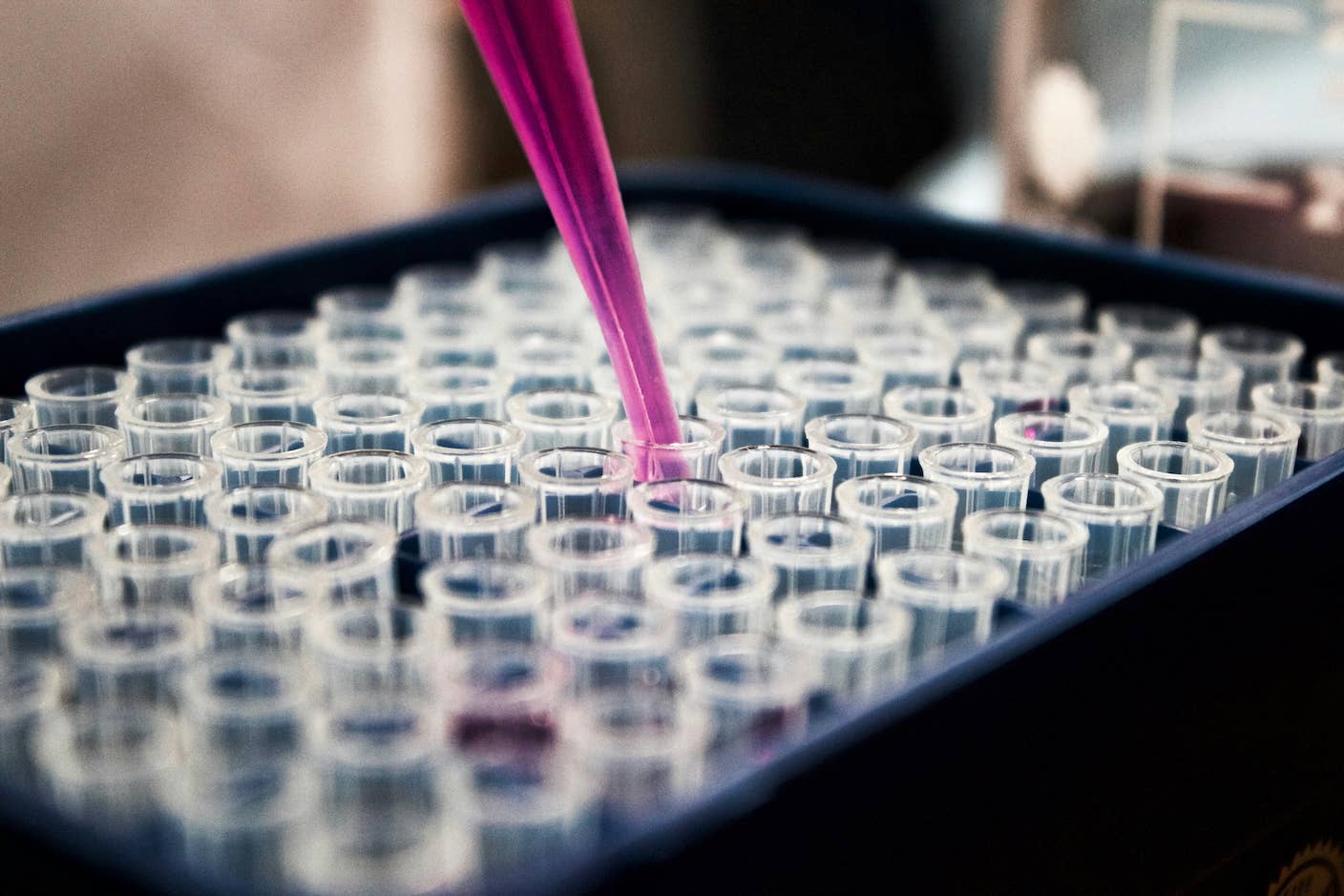
Image Credit
Louis Reed on Unsplash
Share
“Write ‘Intelligence is the ability to adapt to change’ into DNA.”
With that one prompt, the AI lab got to work. One agent scoured scientific literature to devise a workflow. Another translated it into code to control robotic arms. Still more agents guided robots to transfer tiny amounts of reagents and operate DNA synthesis and sequencing machines.
In around 200 hours, the unusual lab, called AutoDNA, completed the entire read-write cycle with a level of precision similar to expert scientists. Humans popped in occasionally to empty trash cans and replenish supplies. But for the most part, AI agents took the wheel.
Much of chemistry and molecular biology relies on complex but repetitive tasks. A tiny slip-up can torpedo hours, if not days or weeks, of painstaking work. The long hours, physical demands, and sheer boredom eventually takes a toll.
Offloading repetitive workflows to “self-driving” labs could free up time for scientists to focus on the bigger picture: Analyzing results, refining hypotheses, brainstorming ideas, and networking with peers.
AI systems have already been “tremendously useful in science,” wrote James Zou at Stanford University, who was not involved in the work. But most focus on computational tasks. Hands-on experiments involving liquids, chemicals, and biological materials present new challenges.
Rather than retrofitting a wet lab designed for humans, the team from Shanghai Jiao Tong University in China built AutoDNA from the ground up with AI in mind. Guided by an AI “coordinator,” robotic arms can expertly operate over 20 types of common lab equipment, autocorrecting any small hiccups along the way.
“It’s a teaser of what might be possible in the future,” outside expert Reshma Shetty, co-founder of Boston-based biotechnology company Ginkgo Bioworks, told Nature.
Set and Forget
AutoAI is the latest attempt to automate pieces of the scientific discovery process.
Last year, Zou’s group introduced Virtual Lab, where an AI principle investigator leads a team of AI experts through research meetings to tackle a problem, with humans providing feedback. Within days, the team had used the system to design new proteins targeting the Covid-19 virus, some of which were later validated in wet-lab experiments by human scientists. Other systems aimed at speeding up research include FutureHouse’s Robin and Google’s Co-Scientist.
Teams have also pushed autonomy beyond the virtual world.
Scientists at the University of Wisconsin–Madison developed SAMPLE, a self-driving lab that uses a relatively simple AI model to suggest protein tweaks and then directs robots to make and test them. Results are fed back into the model for further improvement. Over a period of six months, the system built a more heat-tolerant enzyme, a feat that would have taken human scientists a year.
Another autonomous lab boosted enzyme activity using sophisticated protein language models to guide robotic experiments. And earlier this year, OpenAI and Ginkgo Bioworks showcased a GPT-5-powered lab that optimized protein synthesis from idea to end result, with minimal human help.
Scientists are also tackling another challenge: Getting pieces of lab equipment that speak different programming languages to “talk” to each other. Recently, Anthropic and collaborators released the Model Hardware Standard, a framework that lets AI agents control everything from microscopes to robotic arms and orchestrate experiments like a seasoned lab tech.
There’s no doubt self-driving labs are getting more sophisticated. But coordinating instrument clusters is one thing; building an entire molecular biology lab around AI agents is another.
Be Part of the Future
Sign up to receive top stories about groundbreaking technologies and visionary thinkers from SingularityHub.

Cruise Control
AutoDNA relies on a team of agents powered by large language models, each handling a different task. A scientist first describes a task in plain language. The machine team then works out the best procedure and generates code to operate equipment (up to over 20 different types).
Guided by agents, a liquid handling robot mixes samples with reagents, shuttles them between instruments, and operates lab machines to synthesize, amplify, and sequence DNA. These seemingly routine tasks, performed hundreds of times or more by a scientist, take tons of practice to master without introducing errors or contamination along the way.
Several case studies proved AutoDNA’s prowess. In one, the system optimized a multiple-step DNA synthesis process known as polymerase chain reaction. It’s a commonly used method, but the recipe isn’t one size fits all. Scientists make subtle changes, depending on the length and letter makeup of the DNA sequence. The system tweaked reaction settings over multiple rounds, achieving a yield of nearly 98 percent, which is similar to that of human experts.
When challenged with finding mutations in a colorectal cancer sample, AutoDNA identified a candidate in KRAS, a gene that spurs cancers when mutated. It next designed and synthesized primers—short DNA strands that initiate the sequencing process—and used them to confirm the suspected mutation.
In another ambitious experiment, the team asked AutoDNA to encode and decode a message in DNA using the molecule’s four-letter alphabet. The operation required 11,382 operations across roughly eight days. Humans weren’t entirely out of the loop. Periodically, they stepped in to restock reagents and disposable labware—pipette tips or glass tubes—and empty trash.
“On detecting a shortage, the system paused the experiment and alerted the technician for replenishment,” wrote the team. In the end, all 78 synthesized DNA strands needed to encode the message were successfully synthesized and decoded, even with a few missing DNA letters.
AutoDNA showed a sort of common sense too. In one test to detect viral DNA, the planner agent instructed a robot to cap the test tubes to prevent samples from evaporating, without explicit instructions to do so.
“This is a small decision, but experimental success depends on many such details that might be obvious to an experienced researcher and are often left out of written protocols,” wrote Zou.
That’s not to say AutoDNA is ready for prime time. Manual restocking may sound trivial, but like food prep and dishwashing in cooking, it’s an integral yet time-consuming part of lab work. The system wasn’t foolproof, logging 14 hardware errors across experiments, 6 of which needed a person to fix. And it can’t yet handle more delicate experiments involving living cells or animals.
Then there’s safety. Even with knowledge about the physical world, AI agents may struggle to operate unfamiliar, expensive equipment. One solution might be to build a digital twin of the lab—a virtual sandbox that lets agents rehearse, refine their plans, and potentially catch errors before attempting experiments in the real world.
Biosecurity is another concern. Without sufficient safeguards, self-driving labs could synthesize DNA encoding potentially dangerous proteins. Building screening software directly into the system, designating access control, and keeping a ledger of who authorized what experiments could help reduce risks.
Still, “the work shows how AI systems can begin to close the gap between proposing an experiment and doing it,” wrote Zou.

Related Articles
What Does the ‘I’ in AI Really Mean?
Science Is Littered With AI Slop. A New Detector Could Filter It Out.
Microsoft’s Medical AI Is Over Twice as Good Diagnosing Diseases as Doctors
What Does the ‘I’ in AI Really Mean?
Science Is Littered With AI Slop. A New Detector Could Filter It Out.
Microsoft’s Medical AI Is Over Twice as Good Diagnosing Diseases as Doctors
What we’re reading