US Issues Grand Challenge: The First Fault-Tolerant Quantum Computer by 2028
Today's error-prone quantum computers are still far from practical. But a bold deadline could galvanize the field.
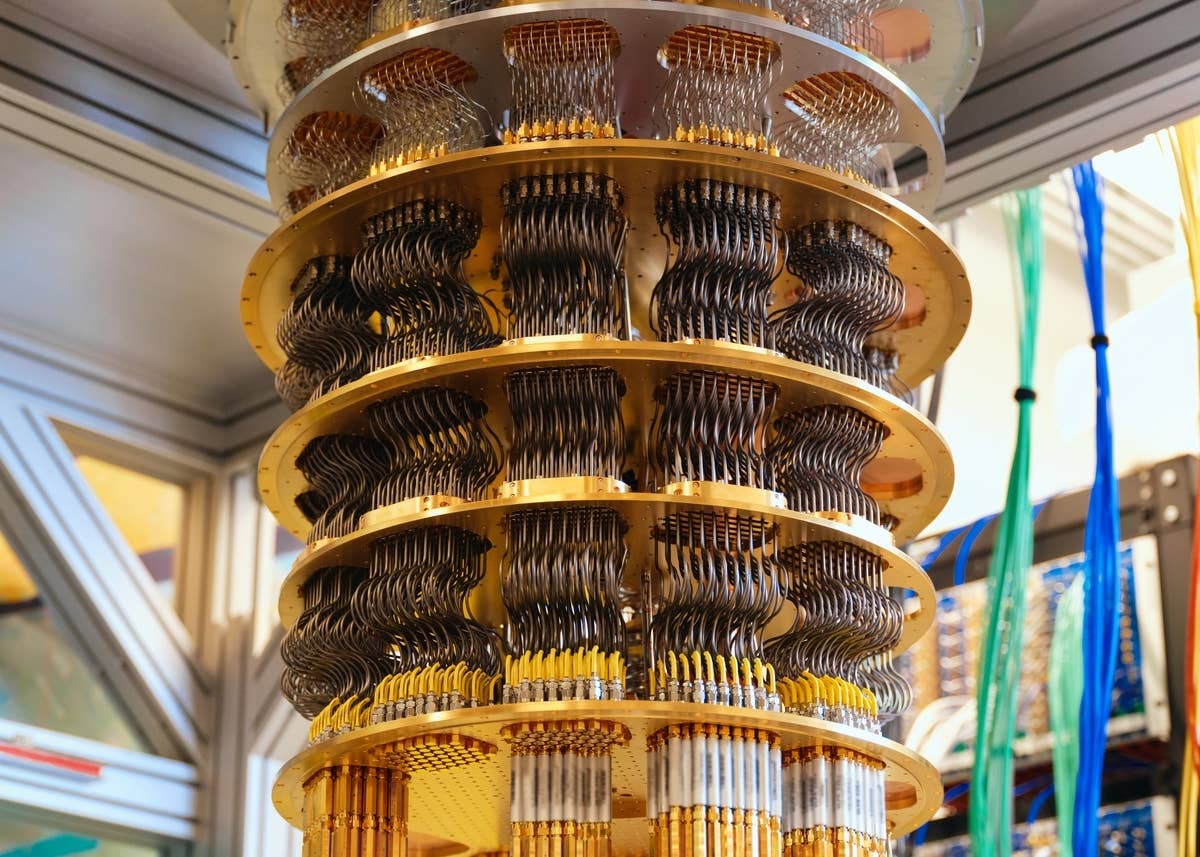
Image Credit
Share
As the race to harness quantum computing accelerates, governments are throwing their hats in the ring. The US Department of Energy is now aiming to build a fully functional, fault-tolerant quantum computer within the next three years.
Despite plenty of breathless headlines about the coming quantum revolution, today’s machines remain a long way from being practically useful. It’s widely expected that we will need much larger, more reliable quantum computers before they can tackle real-world problems.
That’s largely due to the fact that qubits are incredibly error-prone, which means future machines will need to run algorithms to detect and correct those errors faster than they occur. It’s estimated that the overhead for these algorithms could be as high as 1,000 physical qubits to create a single, error-corrected “logical” qubit that can actually take part in calculations.
Given that most current devices feature at best a few hundred physical qubits, more sober heads in the industry have suggested that we may be waiting well into the next decade to see a practical fault-tolerant quantum computer. But last week, Darío Gil, the Department of Energy's undersecretary for science, announced the agency thinks it can hit that milestone in three years.
"By 2028 we will deliver the first generation of fault-tolerant quantum computers capable of scientifically relevant quantum calculations," he told the Office of Science Advisory Committee, according to Science.
The agency doesn’t actually plan to build the system itself; it wants quantum computing companies to provide a ready-made solution. It has set out performance criteria it expects the future device to meet but is leaving the details up to providers. In particular, the agency has not picked a favorite between leading quantum computing designs, such as superconducting qubits, trapped ions, or neutral atoms.
"You can build it however you want, so long as you meet that objective and demonstrate scientific relevance," Gil explained.
The proposed system would likely be housed at one of the department’s national laboratories where researchers can apply to use it for free, with projects selected based on scientific merit.
Be Part of the Future
Sign up to receive top stories about groundbreaking technologies and visionary thinkers from SingularityHub.

The announcement is the latest example of the agency’s growing focus on quantum technology. In November 2025, it announced $625 million to renew its National Quantum Information Science Research Centers, which are designed to accelerate research in quantum computing, simulation, networking, and sensing.
The goal is undeniably ambitious though. There has been significant progress in error-correction technology in recent years, which has renewed optimism in the industry. In particular, Google’s demonstration of its Willow chip in December 2024 proved quantum error correction works in practice, not just in theory. But massive technical hurdles remain, primarily in scaling up the hardware.
"It's a very optimistic but worthy goal," Yale physicist Steven Girvin told Science. Researchers are making “tremendous progress” in error correction, he said, but they’re still far from true fault-tolerance.
Solving that challenge has become an urgent priority for the industry, according to a recent report from quantum computing company Riverlane, but a severe talent shortage may limit how fast the field can move. There are only an estimated 600 to 700 professionals specializing in quantum error correction worldwide, but the industry will need up to 16,000 by the turn of the decade. And training error-correction experts can take up to 10 years.
It’s possible that the kind of grand challenge laid out by DoE can help galvanize both the attention and funding needed to shift the needle. But it’s an open question whether it will be able to deliver on the incredibly bold timeline outlined this week.

Related Articles

Five Ways Quantum Technology Could Shape Everyday Life

Chatbots ‘Optimized to Please’ Make Us Less Likely to Admit When We’re Wrong
These Mini Brains Just Learned to Solve a Classic Engineering Problem
Five Ways Quantum Technology Could Shape Everyday Life
Chatbots ‘Optimized to Please’ Make Us Less Likely to Admit When We’re Wrong
These Mini Brains Just Learned to Solve a Classic Engineering Problem
What we’re reading