Sony’s 360 View 3D Display – The Snow Globe of the Future
Share
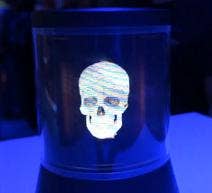
Help me Obi-wan Kenobi...Sony's ripping off our ideas. Since late last year, Sony's been showing off a really cool looking 3D display that's very reminiscent of the holoprojectors in Star Wars. Called the RayModeler, the cylinder like device projects a 360° view of the virtual objects 'inside'. Walk all the way around it and you can see a 3D video from every conceivable angle. Not only that, but you can pick up a video game controller and interact with it, or just wave your hand to play with it, because it has gesture controls and renders images in real time! Sony packed pretty much every single cutting edge visual technology it could fit into this thing. Did I mention you don't need glasses to watch it? Yes, this is one of those badass products that you drive miles to see in person at an electronics convention. The resolution is low (only 96x120) but it's still amazing to watch. Check it out in the videos below. You can bet this thing will be at CES next year.
The RayModeler is what is confusingly referred to as an autostereoscopic display. Basically, it's projecting different images at different angles. Because of parallax, your eyes interpret these different images as a single object with depth. The glasses associated with traditional 3D displays aren't needed. Yay stereoscopic vision! We've seen different companies use parallax for 3D images before, but Sony's taking it to the next level. RayModeler doesn't just project in a few angles, it covers the entire circle. The device emits 360 different images around its cylinder. No wonder this thing can only handle 96x120. If I had to project 360 images at once, I'd be tired too.
Here's the official Sony video for RayModeler
This is actual footage of RayModeler on the floor of SIGGRAPH 2010.
Be Part of the Future
Sign up to receive top stories about groundbreaking technologies and visionary thinkers from SingularityHub.

Here's a more recent video of the device at IFA 2010. Go ahead and turn off the sound, there's some nasty background noise in this one.
While Sony claims that RayModeler is just a prototype, that hasn't stopped them from discussing every single possible application it could have. Teleconference, design, education, etc, etc, etc. I'm not sure it would work for any of those unless it can really improves its resolution. Of course, Sony isn't explaining how it gets 360 points of view in a cylinder, and only describes the display as LED based, so I don't know what the real limitations of scale are. Is it only a matter of computing power before we see the RayModeler able to handle 1920x1080, or are there some unconquerable hardware issues as well? Eh, for the moment I don't really care. If this gets picked up and improved until it can be used as a high definition 3D display, great, I'll buy one. If not...well, I still like looking at it. If you don't bring this to CES 2011, Sony, I'm going to be pissed.
[screen capture credit: Le Journal du Geek]
[video credits: Sony, Core77, Le Journal du Geek]
[sources: Sony Blog]

Related Articles

Hackers Are Automating Cyberattacks With AI. Defenders Are Using It to Fight Back.
Thousands of Everyday Drone Pilots Are Making a Google Street View From Above

Scientists Send Secure Quantum Keys Over 62 Miles of Fiber—Without Trusted Devices
Hackers Are Automating Cyberattacks With AI. Defenders Are Using It to Fight Back.
Thousands of Everyday Drone Pilots Are Making a Google Street View From Above
Scientists Send Secure Quantum Keys Over 62 Miles of Fiber—Without Trusted Devices
What we’re reading